The Doctor’s Complete Guide to Skin Treatments in Worthing
TL;DR — Summary
Healthy skin isn’t about quick fixes — it’s about understanding the Exposome (the 80% of ageing driven by lifestyle and environment) and supporting your skin consistently. Medical‑grade skincare like AlumierMD forms the foundation, with lifestyle habits playing a major role. Regenerative treatments such as polynucleotides, microneedling, skin boosters and peels build on that foundation, while injectables are the final, optional layer — not the starting point. Healthy skin is built, not bought, and it’s never too late to begin.
There’s something quietly powerful about healthy skin.
Not “perfect” skin. Not filtered skin. Not the impossible, airbrushed ideal we see everywhere we look. Just skin that’s supported, understood, and cared for with consistency — skin that reflects the life you’re living and the thought you’re giving it.
If you’re exploring skin treatments and feeling unsure where to start, my doctor‑led aesthetic clinic in Worthing offers calm, evidence‑based guidance.
I often tell my patients: healthy skin is beautiful skin, and it’s never too late to make meaningful changes. Skin is a living organ — dynamic, responsive, and capable of remarkable improvement when we work with its biology rather than against it. I’ve seen this in clinic, again and again. A patient in their sixties with genuinely better skin than they had in their forties, simply because they started doing the right things consistently.
But modern life isn’t gentle on skin…
The Exposome
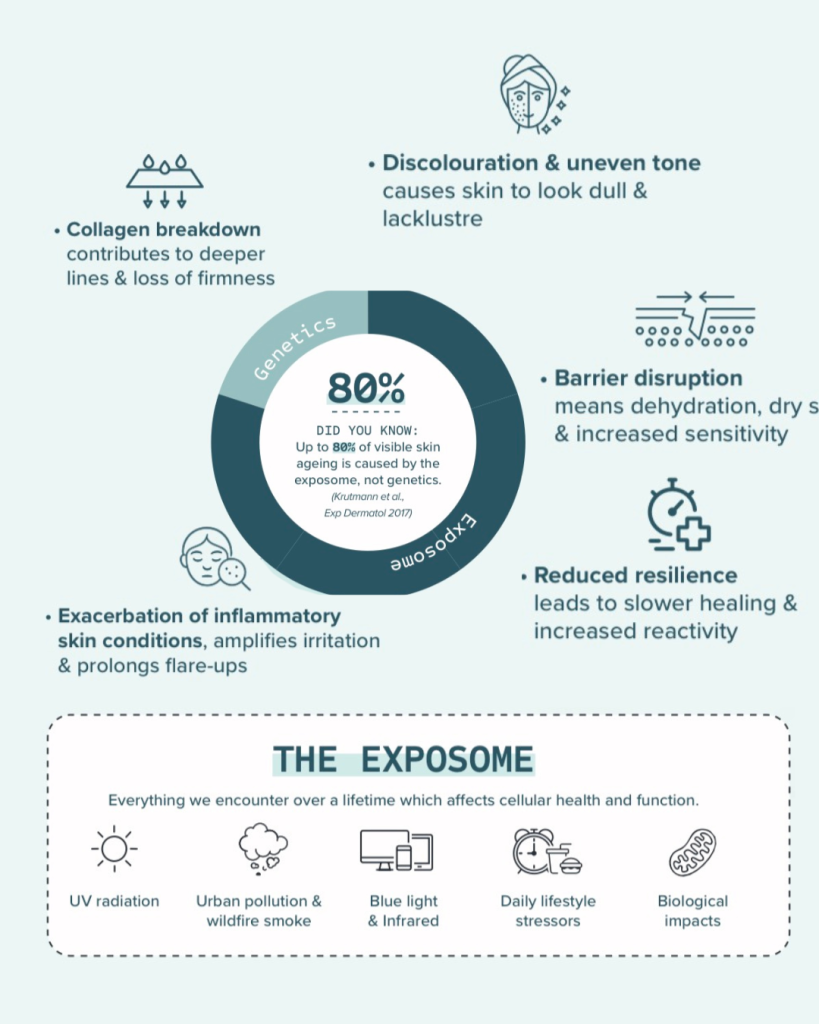
Stress, sleep deprivation, pollution, UV radiation, diet, hormonal shifts, blue light, weather fluctuations — these are all forces acting on your skin every single day. Scientists have a word for this collective environmental load: the Exposome. It describes everything beyond your DNA that influences how your skin ages. And while your genetics set a certain blueprint, research suggests that the Exposome accounts for up to 80% of visible skin ageing. That’s both humbling and hopeful — because it means most of what we see is within our power to influence.
What I offer at Blue Bird Aesthetics isn’t a menu of quick fixes. I use AlumierMD medical‑grade skincare in clinic because it directly targets many of these Exposome‑driven changes.
This is just one part of a considered, doctor‑led framework — grounded in science, guided by your individual goals, and designed to build the kind of skin health that actually lasts. This guide is my way of sharing that framework with you. No hype. No pressure. Just an honest, human explanation of what actually works, and why.
Where Skin Health Really Begins
Before we talk treatments, I want to establish something foundational — because without this, nothing else quite makes sense.
Skin grows and changes continually. It’s in a constant state of renewal, shedding old cells, producing new collagen, repairing daily damage. It doesn’t respond to one-off interventions. It responds to consistency, to sustained signals, and to the right conditions being in place over time.
This is one of the most important things I tell patients, and one of the most commonly misunderstood things about aesthetic medicine. People often arrive expecting:
- Instant, dramatic results from a single session
- An injectable that will improve texture, tone, or glow
- A peel that will undo years of sun damage in one go
- A skincare routine to be optional once treatments start
But skin doesn’t work that way. It needs a foundation. And everything else — every in‑clinic treatment, every course of polynucleotides, every peel — builds on top of that foundation and works better because of it.
Healthy skin is built, not bought
So here, in the order I genuinely believe in, is my treatment hierarchy.
1. Medical‑Grade Skincare: The Foundation Everything Else Depends On
If there’s a hero in this story, it’s this.
Not injectables. Not lasers. Not any single in‑clinic treatment. It’s what you apply to your skin every morning and every evening — and the quality of what that is matters enormously. You can read more about my approach to medical‑grade skincare here.
I use AlumierMD in clinic and recommend it to almost every patient I see, because it represents the clearest example I know of science genuinely leading the conversation. AlumierMD was founded by pharmaceutical researchers — people who understood formulation chemistry, ingredient stability, and the biology of skin repair before they ever thought about branding. The result is a range that performs differently to the products you’ll find in department stores or influenced heavily by marketing spend.
But what does “medical-grade” actually mean?
The term gets thrown around, so let me be specific. What distinguishes medical-grade skincare is:
- Active ingredient concentration. Medical-grade formulations contain actives at clinically effective percentages — not the trace amounts that allow a company to list an ingredient on the label.
- Ingredient stability and penetration. Actives like vitamin C are notoriously unstable. AlumierMD’s EvenTone Brightening Serum, for example, uses a stabilised form of vitamin C that remains active on the skin and can actually reach the target cells, rather than oxidising before it gets there.
- Barrier intelligence. Every formulation is designed with the skin barrier in mind — not just treating the surface, but supporting the structure beneath it.
The skin barrier — and why it’s everything
The skin barrier (technically the stratum corneum) is your skin’s first line of defence. When it’s healthy, it keeps irritants, pollutants, and pathogens out, and keeps moisture in. When it’s compromised — through over-exfoliation, harsh products, environmental stress, or simply ageing — everything else suffers: sensitivity increases, dehydration deepens, pigmentation worsens, and the skin’s ability to respond to treatments diminishes.
A well-designed skincare routine rebuilds and maintains that barrier. It addresses the Exposome daily, neutralising free radicals, supporting cell turnover, and signalling the skin to behave as younger skin does. That’s not something an in-clinic treatment, however effective, can replicate — because those treatments happen once every few weeks. Your skincare happens twice a day, every day.
If I could give every patient one thing, it would be this. Get your skincare right first, and everything that follows becomes more effective.
2. Lifestyle Factors: The Forces We Often Underestimate
Skincare and treatments can do a great deal. But they can’t undo the daily impact of how we live — and I’ll always be honest about that.
The Exposome we discussed earlier is largely made up of lifestyle factors. Here’s what I see most often making a meaningful difference in clinic — for better and for worse:
Sleep. During deep sleep, your body produces growth hormone, which drives cell repair and regeneration. Chronic sleep deprivation elevates cortisol, degrades collagen, impairs barrier function, and increases inflammation. You can see the evidence of poor sleep on skin remarkably quickly.
Stress. Cortisol (the stress hormone) directly breaks down collagen and elastin, increases sebum production, and triggers inflammatory pathways. The gut-skin axis also means that stress-driven digestive disruption can show up on the face as congestion, dullness, or sensitivity.
Nutrition. Skin needs raw materials. Vitamin C is essential for collagen synthesis. Zinc supports healing. Omega-3 fatty acids reduce inflammation and support barrier lipids. Antioxidants from colourful vegetables counter free radical damage. A diet high in refined sugar, meanwhile, drives glycation — a process that literally stiffens and yellows collagen fibres.
Hydration. Even mild dehydration diminishes skin plumpness and light reflection. It’s one of the simplest levers we have.
UV exposure. UV radiation is the single largest contributor to photoageing — driving pigmentation, collagen degradation, loss of elasticity, and DNA mutation in skin cells. Daily SPF use (yes, even in the UK, yes, even in winter) is arguably the single most evidence-based anti-ageing intervention available. It also protects the investment of every treatment you have.
Hormones. Oestrogen, progesterone, testosterone, and thyroid hormones all influence skin behaviour significantly. Peri-menopause and menopause, for example, cause a measurable drop in collagen — up to 30% in the first five years post-menopause. Understanding this context helps us plan treatment more thoughtfully.
These aren’t optional extras. They’re the scaffolding that holds everything else up.
My About page explains how my GP background shapes this lifestyle‑first approach.
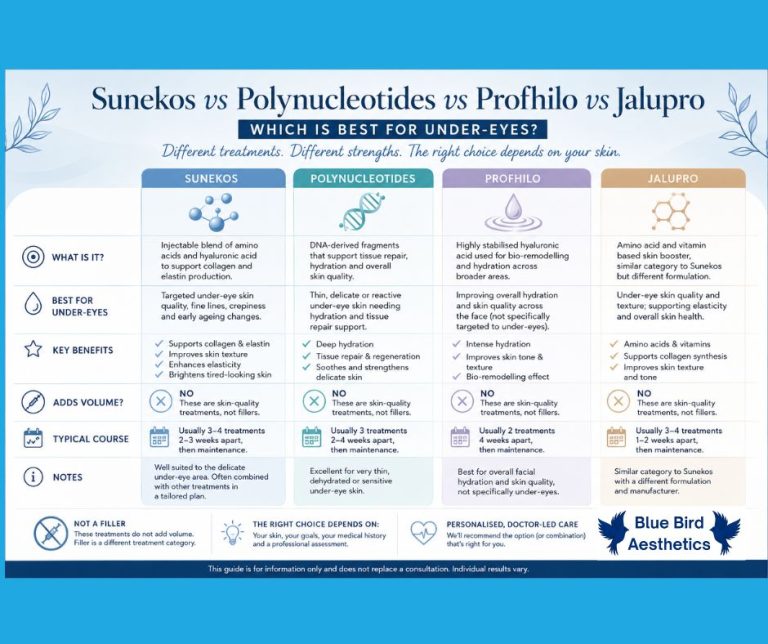
3. Polynucleotides: My Favourite “Aha Moment” in Clinic
Polynucleotides are one of the most exciting developments I’ve seen in aesthetic medicine — not because they’re new and trending, but because they work in a way that genuinely makes biological sense. And when I explain the science to patients, something often clicks.
So here’s how I explain them.
Your skin cells are held together in part by structures called desmosomes — tiny molecular connectors, a bit like the skin cells are holding hands. Over time, through ageing and cumulative Exposome damage, these connections become less dynamic. The cells become a little sluggish. They communicate less efficiently.
Polynucleotides are fragments of highly purified DNA — typically derived from salmon sperm DNA, which has a molecular structure remarkably compatible with human tissue. When we inject them into the skin, they interact with those desmosomes, stimulating the cells to become more active again. If you imagine the desmosomes as elastic bands that haven’t been stretched in a while — stiff, less responsive — the treatment effectively gets them moving again. That’s why patients often feel a brief, sharp sensation during injection: those connections waking up and responding.
As the cells restimulate, the polynucleotide fragments signal repair pathways: increased fibroblast activity, improved hydration (through stimulation of hyaluronic acid synthesis), and genuine tissue regeneration — not just filling or volumising, but biological renewal.
What this looks like in practice:
- Improved skin quality across the face — smoother, more hydrated, more luminous
- Reduction in fine crepey lines, particularly around the eyes and mouth
- Gradual, natural improvement that tends to continue over several months
- Particularly effective for the under-eye area, where conventional fillers can be risky
This is not filler. It adds no volume and creates no artificial change. It’s skin health at a cellular level — which is exactly why I find it so compelling.
You can learn more about how I use regenerative treatments in clinic during a consultation.
4. Microneedling: Collagen Stimulation With Purpose
Microneedling works on a principle that sounds counterintuitive at first: controlled damage to create improvement.
A device with fine needles creates thousands of micro-channels in the skin’s surface. These micro-injuries are real but minimal — they trigger the skin’s wound-healing cascade without the recovery time or risk of more aggressive resurfacing treatments. The key players in that cascade are fibroblasts — the cells responsible for producing collagen and elastin.
In response to microneedling, fibroblasts become significantly more active. They lay down new collagen and elastin fibres, which gradually improve:
- Skin texture and surface smoothness
- The appearance of acne scarring and enlarged pores
- Fine lines and mild laxity
- Skin radiance and overall quality
The important caveat — one I always share honestly — is that collagen remodelling takes time. New collagen fibres mature and reorganise over three to six months. This is why a course of treatments, spaced appropriately, produces far better results than a single session, and why patience is genuinely part of the process.
Microneedling also significantly enhances the penetration of topical actives applied during or after treatment — which is one reason good skincare and microneedling work so well together.
Read more about Microneedling and Nanoneedling here.
5. Other Skin Boosters: Hydration Where It Actually Matters
Skin boosters — typically highly cross-linked or low-cross-linked hyaluronic acid injected in small amounts across a treatment area — work differently to dermal fillers. Rather than adding structure or volume, they improve the skin’s intrinsic hydration, elasticity, and surface quality.
Hyaluronic acid is naturally present in the skin’s dermis, where it binds water molecules and maintains the plumpness and bounce we associate with youthful skin. As we age, its concentration decreases — a process accelerated by UV exposure and other Exposome factors.
Skin boosters replenish this, improving:
- Skin luminosity and light reflection
- Surface smoothness and softness
- Fine crepey lines caused by dehydration
- The skin’s response and resilience to environmental stressors
They’re particularly well-suited as a complement to good skincare and polynucleotides — not a replacement for either. The best results I see clinically come when the skin is well-supported from multiple angles simultaneously.
6. Chemical Peels: Resetting the Surface
Chemical peels work by applying an acid solution to the skin to accelerate cell turnover — removing the outermost layers of dead, damaged, or pigmented cells and prompting the skin to regenerate a fresher surface beneath.
Different acids work in different ways and at different depths:
- AHAs (glycolic, lactic) work primarily on the surface and are excellent for dullness, uneven texture, and mild pigmentation
- Salicylic acid is lipid-soluble, meaning it penetrates into pores — making it particularly effective for congestion and breakout-prone skin
- TCA (trichloroacetic acid) reaches deeper dermal layers and is used for more significant pigmentation and resurfacing
The peels I use are from the AlumierMD range, and this matters. The formulations are buffered and designed to deliver consistent, predictable results — the active ingredients are stable, the pH is precisely calibrated, and the supporting ingredients protect the barrier during the process. That’s a significant difference from peels that lead with marketing and follow with chemistry.
A course of peels works best as part of a broader skin health plan — alongside good skincare and appropriate lifestyle support — rather than as a standalone intervention.
Learn more about the resurfacing peels I use that are research‑driven and barrier‑intelligent.
7. Injectables: The Finishing Touches, Not the Foundation
Anti-wrinkle injections and dermal fillers remain some of the most requested treatments in aesthetic medicine, and used thoughtfully, in the right patients, they absolutely have a place.
But I want to be honest about what they can and can’t do — because I think this is one of the most important conversations to have.
Anti-wrinkle injections (botulinum toxin) temporarily relax the muscles responsible for expression lines — frown lines, forehead lines, crow’s feet. They can soften lines beautifully and, used preventatively in younger patients, may slow the rate at which dynamic lines become static ones. What they don’t do is improve skin texture, hydration, tone, or barrier function.
Dermal fillers restore lost volume and can address structural changes that come with ageing — the redistribution of fat, the reshaping of facial bones, the deepening of certain folds. When placed by a medically trained practitioner who understands anatomy, they can look entirely natural. When over-used or mis-placed, the results speak for themselves.
This is why injectables sit at the end of my hierarchy, not the beginning. They work best when the skin beneath them is genuinely healthy — hydrated, well-structured, well-maintained. A beautiful injectable result on poorly maintained skin is like a fine painting on a crumbling wall. The foundation matters.
So — Which Treatment Is Right for You?
The honest answer is: it depends on you specifically — your skin concerns, your lifestyle, your goals, your medical history, and where you are in your skin health journey.
But here’s what I know to be true across almost every patient I see:
The ones who get the best results are the ones who take the long view. Who invest in their skincare. Who understand that treatments are amplifiers, not shortcuts. Who come back consistently and build on what they’ve started.
Healthy skin is built, not bought. And it’s never too late to start building.
If you’d like a calm, considered, doctor-led assessment of where your skin is now and what it needs, I’d love to help you work that out — without pressure, without a hard sell, and without any treatment you don’t genuinely need.
Where Most Patients Start
Most people don’t arrive with a clear plan — they arrive with questions. Over time, I’ve noticed three common starting points:
If you’re new to skin treatments
We usually begin with AlumierMD skincare and one gentle in‑clinic treatment such as microneedling or a light peel. This builds a strong foundation and helps your skin respond better to everything that follows.
If your main concern is ageing
A combination of polynucleotides and medical‑grade skincare is often the most effective first step. These treatments support the skin at a cellular level and improve quality, hydration and resilience.
If you want a subtle, refreshed look
Skin boosters or microneedling can brighten, smooth and hydrate without changing your natural features. These treatments work beautifully when your skincare is already in a good place.
Where you start isn’t about age or how your skin “should” look — it’s about what will genuinely support your skin long‑term.
If you are choosing a clinic, use my Safe Aesthetics guide to help you make informed choices.
To learn more about Aesthetics, you can also read my Ultimate Guide to Aesthetics Blog

Doctor‑led medical aesthetics clinic in Worthing, West Sussex. Focused on enhancing natural beauty, improving overall skin quality and adhering to clinically safe treatment pathways.
Unsure where to start? Try our doctor-designed Treatment Finder Quiz