Skin Boosters vs Polynucleotides vs Microneedling: Which Is Right for Your Skin?
A doctor-led guide to choosing between the three most-asked-about ‘regenerative’ treatments — honestly, and without the marketing
By Dr Amber Halliday, MRCGP MBBS BSc (Hons), GP & Aesthetics Doctor · Blue Bird Aesthetics, Worthing · Updated 2026
| TL;DR — Key Takeaways |
| Short on time? Here’s the summary: |
| ✓ All three treatments improve skin quality, but they work through entirely different mechanisms. ‘Better’ depends on what you want. |
| ✓ Skin boosters — such as Profhilo — are injectable hyaluronic acid for hydration, elasticity, and quality. Best for dryness, dullness, and post-menopausal crepiness. |
| ✓ Polynucleotides are injectable purified DNA fragments that stimulate the skin’s own repair cells. Best for under-eye work, early laxity, and skin that has lost its bounce. |
| ✓ Microneedling uses controlled micro-injuries to stimulate collagen and elastin. Best for texture, pore appearance, and acne scarring — and the most affordable of the three. |
| ✓ Combination plans are often the right answer — these treatments complement each other rather than compete. |
| ✓ All three are unsuitable in pregnancy, breastfeeding, and active skin infections — contraindications are discussed at consultation. |
| ✓ The right treatment depends on your skin, your goals, and your tolerance for downtime. A calm, considered, commitment-free consultation is the right starting point. |
‘Which one should I have — skin boosters, polynucleotides, or microneedling?’ is one of the most common questions I am asked in consultation. The three treatments come up together because they all share a similar goal: improving the quality of the skin rather than reshaping the face. They all promise subtle, gradual improvements rather than dramatic transformations. And they are all marketed under the same broad banner of ‘regenerative aesthetics’.
Here in Worthing I see these treatments requested more than almost any others. The coastal climate, the cumulative sun exposure many of my patients have had over the years, and a sizeable peri- and post-menopausal local demographic all point towards the same set of concerns: hydration, texture, elasticity, and skin quality rather than facial restructuring. These three treatments are the most commonly considered answers — which is why getting the choice right matters.
They are not interchangeable. They work through entirely different mechanisms, suit different concerns, and produce different patterns of results. The right choice depends on what you actually want from your skin — which is a more useful question than ‘which is best?’ in the abstract. This guide compares the three honestly, side by side. My philosophy is the same for every consultation: understand the patient first, then choose the treatment — never the other way around.
“These three treatments are often presented as competitors. They are not. They are different tools for different jobs — and one of the most useful things a doctor-led consultation can do is help you work out which job your skin actually needs done.”
— Dr Amber Halliday, MRCGP MBBS BSc (Hons)
Who This Guide Is For
This guide is for anyone in Worthing or the surrounding area who is weighing up skin quality treatments and trying to choose between them. You may have been recommended one specific option by another clinic. You may have seen all three named on social media and not been able to tell them apart. You may be returning to aesthetics after a break and finding the landscape has changed.
It is also for patients who have already had one of these treatments and are wondering whether to repeat it, add another, or do something different. The right next step is not always more of the same — sometimes a different treatment will give better results for less money. That is a conversation worth having before booking.
It is not a guide to dermal fillers, anti-wrinkle injections, or surgical interventions. The three treatments compared here are non-volumising treatments focused on skin quality — a deliberately narrower focus.
1. Why These Three Treatments Get Confused
Skin boosters, polynucleotides, and microneedling are all marketed using broadly similar language: ‘regenerative’, ‘skin quality’, ‘hydration and glow’, ‘collagen-stimulating’. Patients are not being unreasonable when they cannot tell them apart — the marketing actively encourages the confusion.
Underneath the marketing, though, the mechanisms are completely different. Skin boosters work by delivering a specific molecule (hyaluronic acid) into the skin to support its hydration and elastic properties. Polynucleotides work by delivering biological signals that activate the skin’s own repair cells. Microneedling works mechanically — small needles create controlled micro-injuries that trigger the skin’s natural wound-healing response, building new collagen and elastin in the process.
Because the mechanisms differ, so do the results. Skin boosters tend to give a fairly quick improvement in hydration and surface quality. Polynucleotides give a slower, deeper, more structural improvement in the underlying tissue. Microneedling produces gradual improvement in texture and fine lines as new collagen forms. None of them is ‘better’ in the abstract — they are better or worse fits for what you actually need.
Four things social media tends to get wrong
- Skin boosters are not dermal fillers — they do not add volume, and they will not lift or restructure the face.
- Polynucleotides are not an instant treatment — they reward patience. If you expect change within a fortnight, you will be disappointed.
- Professional microneedling is not the same thing as a home dermaroller — the depth, sterility, and technique are meaningfully different.
- ‘Regenerative’ is a useful clinical term, not a synonym for ‘anti-ageing miracle’. These treatments improve skin quality — they do not stop time.
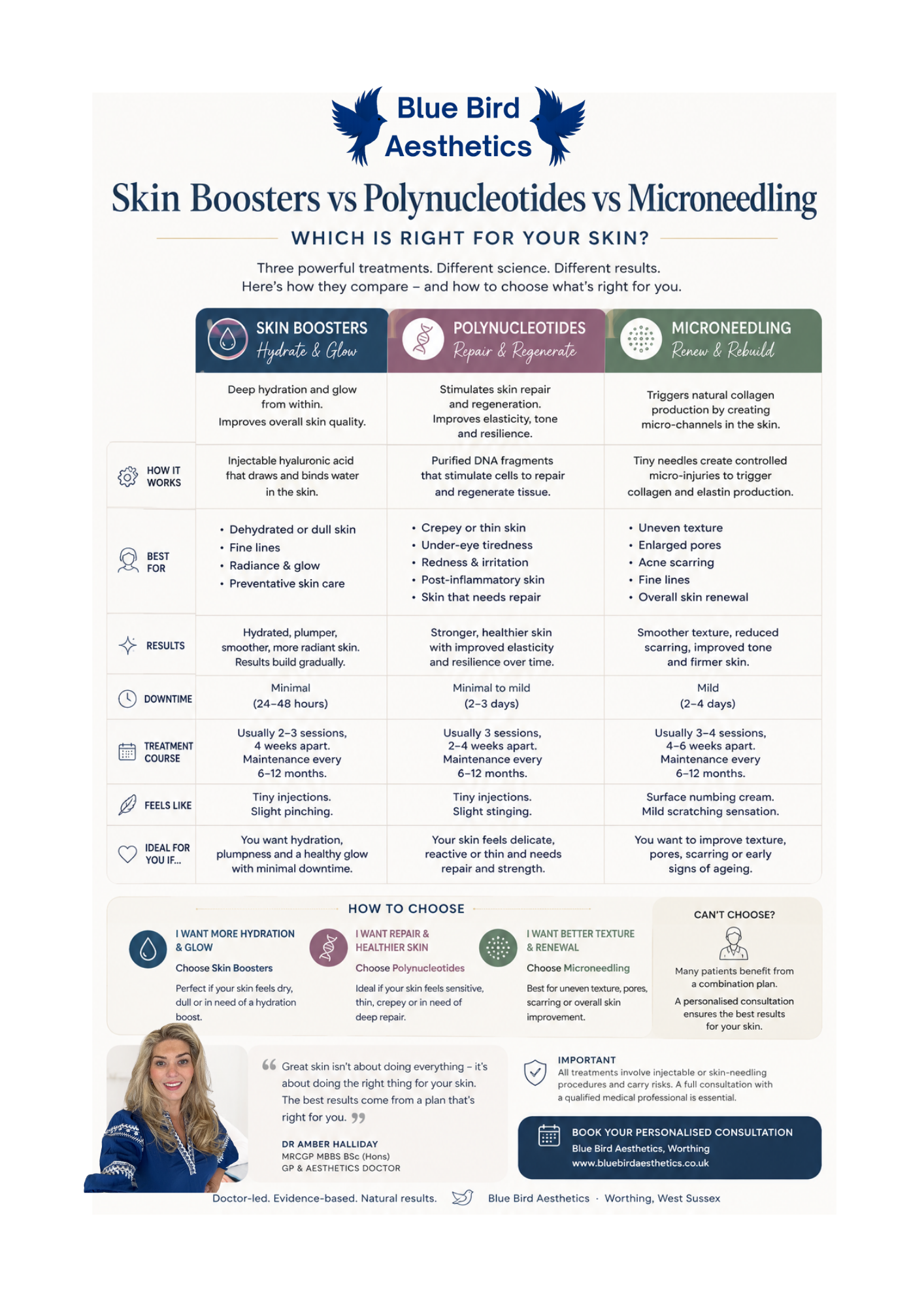
2. The Quick Comparison
Before going into each treatment in detail, here is the side-by-side comparison many patients find most useful. The figures below are general guides — individual plans are confirmed at consultation, where I take into account your skin, your goals, and the specific concerns you have.
| Skin Boosters | Polynucleotides | Microneedling | |
|---|---|---|---|
| What it is | Injectable hyaluronic acid | Injectable DNA-derived biostimulator | Needle-based device treatment |
| How it works | Hydrates and improves elasticity | Stimulates fibroblasts and tissue repair | Triggers collagen via controlled micro-injury |
| Best for | Dryness, dullness, crepey skin | Under-eyes, early laxity, regeneration | Texture, pores, fine lines, acne scarring |
| Downtime | Minimal — small bumps for 24–48 hrs | Minimal — small bumps for 24–72 hrs | 24–48 hrs of redness |
| Sessions to start | 2 sessions, 4 weeks apart | 2–3 sessions, 2–4 weeks apart | 3–6 sessions, 4–6 weeks apart |
| When you see results | Within 2–4 weeks | 4–8 weeks, building over months | 6–12 weeks, cumulative |
| Longevity | Around 6 months | 6–12 months | Builds and persists with maintenance |
| Relative cost | ££ | £££ | £ |
The rest of this guide unpacks each treatment in turn. If you already know which one matches your goals, skip to that section. If you are not sure, the values-based decision guide in section 6 — and the ‘How I Decide in Clinic’ section that follows it — are the most useful starting points.
3. What Skin Boosters Do
Skin boosters are injectable formulations of hyaluronic acid (HA) — the same family of molecule as dermal fillers, but used very differently. Where fillers are designed to add volume in a specific location, skin boosters are spread across an area to improve the overall hydration, elasticity, and quality of the tissue. They do not change the shape of your face. They change the surface of it.
Profhilo is the most widely recognised skin booster brand in the UK, and patients often ask about it by name. It is worth knowing that Profhilo is a specific product within the skin booster category — not a separate category of its own. There are other equally valid skin booster formulations, each with slightly different properties. At consultation we discuss which is most appropriate for your specific concerns.
Best for
Patients with persistent dryness, dullness, crepiness, or a generally tired-looking surface to the skin. Skin boosters are particularly useful for women in perimenopause and post-menopause whose skin has become drier and less plump than it once was — a demographic well represented in Worthing and the surrounding villages. They are also useful for younger patients who want to support their skin quality preventatively.
What to expect
A standard course is usually two sessions, four weeks apart, with maintenance every six months. Sessions take 20 to 30 minutes. Small bumps at the injection sites are normal and settle within 24 to 48 hours. Most patients see a meaningful improvement in surface quality within two to four weeks.
What skin boosters will not do
They will not lift, restructure, or volumise the face — those are different treatments with different products. They will not address deep static lines or significant laxity. They will not eliminate the need for a good topical routine and daily SPF. Honest framing matters here: skin boosters improve skin quality meaningfully, but they are not a transformation.
4. What Polynucleotides Do
Polynucleotides are short chains of purified DNA fragments — derived from salmon DNA — that signal the skin’s own repair cells (fibroblasts) to become more active. The injected polynucleotides are biocompatible with human tissue and act as a regenerative signal rather than a structural product. They are the most genuinely ‘regenerative’ of the three treatments in this guide.
I want to mention something I always tell patients in clinic, because it matters to me even when it does not always matter to them. The polynucleotide products I use are sourced from manufacturers whose salmon come from responsibly managed, well-regulated fisheries with strong welfare standards. I have looked into this carefully. It is the kind of detail patients rarely think to ask about — but I would rather you knew where the product comes from than not.
Where skin boosters add hydration that you can feel within weeks, polynucleotides work at a slower, deeper level. The improvement is structural — better elasticity, firmer tissue, more resilient skin. Results build over weeks to months as fibroblast activity translates into measurable changes in collagen and elastin production.
Best for
Polynucleotides are particularly useful in the under-eye area, where the tissue is too delicate for many other treatments and where regenerative work shows beautifully. They are also valuable for early laxity, fine lines, and skin that has ‘lost its bounce’ — often described by patients in their late 30s and 40s. Many post-menopausal patients benefit too, particularly when combined with the right topical regime.
What to expect
A standard course is usually two to three sessions, two to four weeks apart, with maintenance every 6 to 12 months. Downtime is minimal — small bumps at the injection sites that settle in 24 to 72 hours. Results start to become visible at four to eight weeks and continue to develop for several months afterwards.
What polynucleotides will not do
They are not a quick fix. If you want a visible ‘wow’ result in the first fortnight, polynucleotides will probably disappoint you. They reward patience. They also will not address volume loss or significant structural concerns — those are different conversations.
“Polynucleotides are some of the most rewarding treatments to deliver because the results come from the patient’s own tissue responding. But that is also why they take time. The patients who do best are the ones who go in expecting steady improvement, not overnight change.”
— Dr Amber Halliday
5. What Microneedling Does
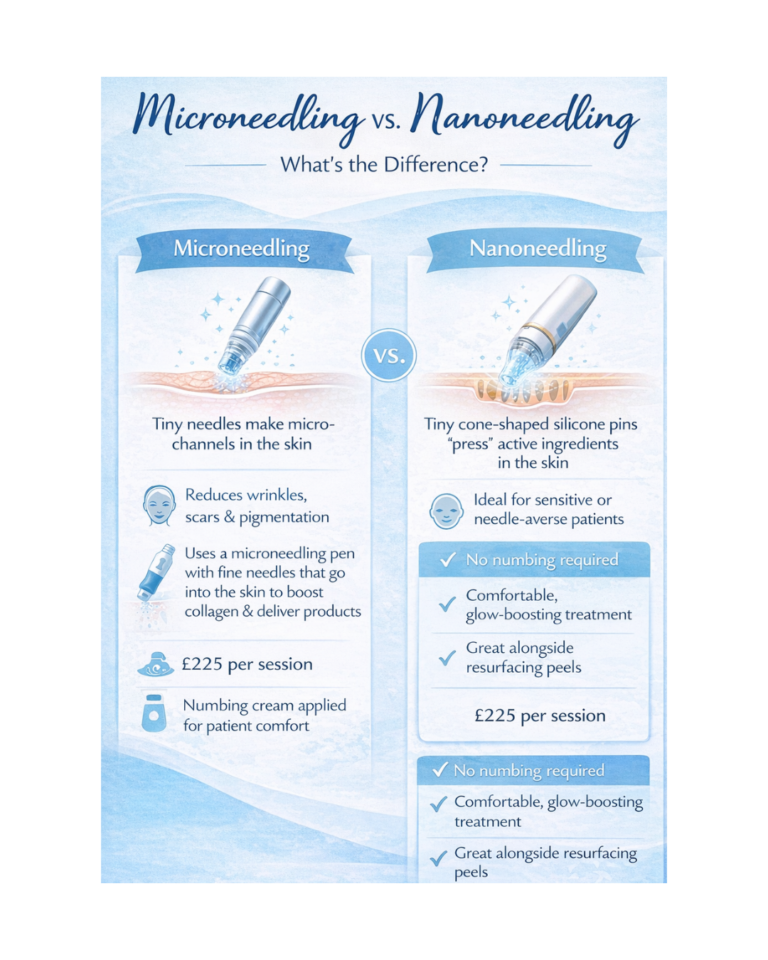
Microneedling is the most mechanically straightforward of the three treatments, and the most affordable. A device with very fine needles creates controlled micro-injuries in the skin. These tiny injuries trigger the skin’s natural wound-healing response, which includes producing new collagen and elastin. Over time, this rebuilds and strengthens the underlying tissue.
Crucially, professional microneedling is meaningfully different from home dermarollers. The depth, sterility, and technique used in clinic produce a clinical effect that consumer devices cannot match. I am not against patients having something at home for maintenance, but I would not recommend it as a replacement for professional treatment.
Best for
Microneedling has the strongest evidence base of the three treatments for treating acne scarring — it is one of the most effective non-invasive options available, and remains first-line for that indication. It is also excellent for skin texture, the appearance of large pores, fine lines, and overall dullness. It works particularly well for younger patients and those in early perimenopause, where the skin’s healing response is still robust.
What to expect
A standard course is usually three to six sessions, four to six weeks apart. Sessions take 45 to 60 minutes including topical anaesthetic. Expect 24 to 48 hours of pinkness afterwards (mild sunburn-like appearance) followed by a couple of days of dryness as the skin sheds. Most patients can return to work the day after treatment with makeup, though I generally suggest planning treatment for a day when you do not have major social commitments the next morning.
What microneedling will not do
It will not deliver volume, hydration, or regeneration at the cellular level the way the other two treatments can. It also requires patience — you will not see the full results until several weeks after your final session, as new collagen takes time to form. And it requires consistent SPF afterwards: heading into sunlight on freshly microneedled skin is one of the easier ways to undo the work you have just paid for.
6. Which One Should You Choose? A Values-Based Guide
Most patients arrive at consultation with a clear sense of what bothers them about their skin, even if they do not know which treatment matches it. The questions below are the ones I most often use to help patients work out which treatment makes most sense as a starting point.
‘I want hydration, plumpness, and a fresher-looking surface’
Skin boosters are usually the right answer. Two sessions four weeks apart, then maintenance every six months. Results visible within 2–4 weeks. Particularly worth considering if you are perimenopausal or post-menopausal.
‘I want under-eye improvement and a more rested look’
Polynucleotides are usually the right answer. They work beautifully in the delicate peri-orbital area where other treatments are too aggressive. Allow 4–8 weeks to see initial change, with results building over several months.
‘I want better skin texture, fewer visible pores, or improvement in acne scarring’
Microneedling is usually the right answer — and remains the most evidence-based non-invasive option for scarring specifically. Plan for a course of 3–6 sessions, with results developing over the months afterwards.
‘I want to start with whichever gives the best value for a single course’
Microneedling typically offers the most accessible entry point, both in cost and in the breadth of concerns it addresses. Skin boosters are the next step up; polynucleotides represent a more significant investment but with longer-lasting regenerative effect. We can talk through budget honestly at consultation — no judgement either way.
‘I want regeneration and improvement at a deeper level than any of these can offer’
NeoGen plasma may be the right conversation. It works deeper than microneedling, with results that can last 12–24 months. The downtime is greater — typically several days — but for the right patient the trade-off is worth it. Discussed in detail in our NeoGen guide.
‘I want all of the above’
A combination plan is the right answer. We sequence treatments so each one supports the others — and so the budget is spent where it gives you the most value. See section 8 for how this works in practice.
Want a more interactive walk-through?
If you would prefer a guided self-assessment before booking a consultation, the ‘What treatment is right for you?’ quiz on the Blue Bird Aesthetics website asks a short series of questions and points you towards the most likely best fit. It is not a substitute for clinical assessment — but it is a useful starting point if you are still narrowing things down.
7. How I Decide in Clinic: A GP’s Approach
In clinic, I do not start with the treatment — I start with the skin. The values-based callouts in section 6 are useful for narrowing things down at home, but the consultation itself goes further. I take a systematic look at hydration levels, surface texture, dermal thickness, pore pattern, any scarring (and what kind), pigmentation, and signs of laxity or sun damage. I also ask about your general health, any medications, hormonal stage, sleep, stress, sun exposure, and what your topical routine actually looks like day to day. Only then do I match the mechanism to what your skin actually needs.
Being a GP as well as an aesthetics doctor changes the conversation. I am thinking about your skin as a clinical organ, not just a cosmetic surface — which means rosacea flares, perimenopausal changes, autoimmune skin conditions, and medication-related dryness are all part of the assessment. Sometimes the most useful thing I can do is recognise that an aesthetic treatment is not the right next step yet — and suggest a topical regime, a GP review, or simply some patience before considering anything more interventional.
Patterns I see often in Worthing
Years of consulting in this part of West Sussex has given me a feel for the patterns that recur locally. None of what follows is a diagnosis, of course — just the kinds of presentations I match to treatment most often:
Patients in their 40s and 50s presenting with a mix of perimenopausal dryness and early laxity typically benefit from a combined plan: skin boosters for the hydration deficit, polynucleotides for the elasticity and regeneration. This is one of the most common combinations I prescribe.
Younger patients (20s and 30s) with active or healed acne and the textural changes that follow tend to do best with microneedling as the primary treatment, with polynucleotides considered later if regenerative support is needed. Acne scarring is one of the strongest indications for microneedling, full stop.
Patients with primarily under-eye concerns — fragile, crepey skin and a tired-looking quality (separate from true volume loss) — are usually best matched to polynucleotides. The peri-orbital area is one of the most rewarding to treat with this product.
Patients who have been outdoors for work or leisure in the Worthing coastal environment for many years often need texture and tone correction rather than hydration: microneedling, sometimes combined with NeoGen plasma where the photo-damage runs deeper, is usually the right conversation.
Who I would not treat with these, even if they ask
I do not recommend microneedling for patients with uncontrolled rosacea — the inflammatory response can flare and undo the benefit. I do not recommend polynucleotides for patients who tell me they want results in two weeks for a specific event — the expectation mismatch leads to disappointment. And I do not recommend skin boosters for patients whose primary concern is loss of facial volume — they will not get the outcome they are looking for, and the budget is better spent on a different treatment. Sometimes the most useful clinical sentence I can say is ‘this is not the right treatment for what you actually want’.
8. Combination Approaches
These treatments are not competitors. They are tools that work well together when sequenced thoughtfully. Many of the best results I see in clinic come from combinations rather than any single treatment used alone.
Skin boosters + microneedling
A useful combination for patients who want both hydration improvement and texture improvement. Typically I would sequence microneedling first (to build the collagen base), then introduce skin boosters once the active microneedling course is complete — or alternate them across the year for ongoing support.
Polynucleotides + microneedling
A particularly effective combination for patients in their late 30s and 40s who want both surface improvement and regenerative work at a deeper level. Polynucleotides do not undo microneedling work — they amplify it. Sessions are sequenced rather than performed on the same day.
Skin boosters or polynucleotides + NeoGen
For patients who have invested in deeper regenerative work with NeoGen plasma, skin boosters or polynucleotides can be used in the months following to optimise the result. NeoGen does the heavier lifting; the injectables refine and extend the benefit. Our guide to NeoGen explains how this longer-term planning works.
An honesty point about combinations
Combinations are not always the right answer. Sometimes the right plan is one treatment, done well, with maintenance. I will only recommend combinations where the evidence and the budget justify them — not as a default. Patients deserve to see what a single treatment can do before adding a second.
9. Who Should Avoid Each Treatment
None of these treatments is universally suitable. The contraindications below are general guides — every consultation includes a personalised assessment, and individual circumstances may make a treatment more or less appropriate than the list suggests.
Common to all three
Pregnancy and breastfeeding (the conservative position, taken across UK aesthetic medicine, is to avoid these treatments in these life stages). Active skin infection at the proposed treatment site. Recent significant sun exposure or sunburn. Active inflammatory skin conditions in the area to be treated. A history of poor or delayed wound healing. Certain immunosuppressive conditions or medications, which need a tailored conversation.
Specific to skin boosters and polynucleotides
Known allergy to hyaluronic acid (skin boosters) or to polynucleotides or their derivation source. Active autoimmune flares may require pausing treatment. Patients on blood thinners need a careful discussion about bruising risk — we usually still proceed, with extra care.
Specific to microneedling
Active acne (microneedling can spread bacteria across the skin and worsen breakouts). Recent isotretinoin treatment (the conventional guidance is to wait six months after stopping, though more recent evidence is moving towards shorter intervals — a personal medical conversation is needed). A personal history of keloid or hypertrophic scarring, where the wound-healing response can be overactive. Recent chemical peels or laser treatments in the same area within the previous 4 to 6 weeks.
If you are not sure whether you are suitable
Bring it to consultation. A 20-minute conversation is enough to determine suitability accurately, and the consultation is not a commitment to treatment. The right answer is sometimes that one of these treatments is not for you right now — but another one is.
10. How to Prepare and How to Recover
These are the practical instructions I give patients before and after each treatment. The principles are similar across all three, with some treatment-specific differences worth knowing about.
| Skin Boosters | Polynucleotides | Microneedling | |
|---|---|---|---|
| Avoid alcohol | 24 hrs before | 24 hrs before | Not essential, but advisable the night before |
| Avoid retinoids | Not essential | Not essential | Pause 48 hrs before |
| Avoid blood-thinning supplements | 1–2 days before, where medically safe | 1–2 days before, where medically safe | Same |
| Sun exposure before | Avoid significant sun 48 hrs before | Avoid significant sun 48 hrs before | Avoid sun and tanning beds for at least a week before |
| Make-up on day of treatment | Removed in clinic | Removed in clinic | Removed in clinic |
| Exercise & sauna after | Avoid for 24 hrs | Avoid for 24 hrs | Avoid for 48 hrs |
| Make-up after | Light makeup the next day | Light makeup the next day | Mineral makeup from 24–48 hrs |
| SPF after | SPF 50 daily | SPF 50 daily | SPF 50 daily, religiously, for at least 2 weeks |
| Resume normal skincare | Within 24 hrs | Within 24 hrs | Bland barrier-focused care for 3–5 days, then reintroduce |
Specific written aftercare instructions are issued at the end of every treatment, tailored to your skin and to anything we have agreed in clinic. The table above is the general framework, not a substitute for that personalised advice.
Not sure which is right for you?
Book a calm, considered, commitment-free consultation with Dr Amber Halliday at Blue Bird Aesthetics, Worthing. We’ll work out together what your skin actually needs — and what it doesn’t.
→ Book a consultation at Blue Bird AestheticsFrequently Asked Questions
Can I have all three of these treatments?
Yes — but staged rather than at once. Each treatment has a different recovery and result pattern, and combining them in a single session is rarely the right approach. A typical combination plan might involve microneedling now, polynucleotides in 4 to 6 weeks, and skin boosters at the 6-month review point. The sequence is personalised at consultation.
Which one will I see results from the fastest?
Skin boosters typically give the fastest visible change — most patients notice an improvement in hydration and surface quality within 2 to 4 weeks. Polynucleotides take longer to translate into visible change (4 to 8 weeks for the initial signal, building over months). Microneedling results are the most gradual but the most cumulative — the full benefit of a course often appears 3 to 6 months after the final session.
Which gives the longest-lasting results?
Polynucleotides usually offer the longest duration from a single course (6 to 12 months). Skin booster results last around 6 months before maintenance is needed. Microneedling results are different in nature — they build with each session and are largely retained as new collagen, so the question of ‘how long do they last’ doesn’t apply in quite the same way. SPF and skincare matter more for maintaining microneedling results than any clinical schedule.
Are these treatments safe during pregnancy or breastfeeding?
The conservative position taken across UK aesthetic medicine is to avoid all three treatments during pregnancy and breastfeeding. This is not because there is strong evidence of harm — it is because the absence of safety data in these populations means we err firmly on the side of caution. Restarting after breastfeeding ends is straightforward.
Are the salmon used to make polynucleotides ethically sourced?
I check this carefully before choosing which polynucleotide product to use. The polynucleotide products I administer come from manufacturers whose salmon are sourced from responsibly managed, well-regulated fisheries with established welfare standards. It is the kind of detail patients rarely think to ask about, but I would rather you knew.
How many sessions do I need overall?
A starter course is typically 2 sessions for skin boosters, 2 to 3 sessions for polynucleotides, and 3 to 6 sessions for microneedling. Maintenance schedules differ — around 6 months for skin boosters, 6 to 12 months for polynucleotides, and ongoing variable for microneedling depending on how well the results hold. We agree the plan at consultation, including what you can space out if budget is a factor.
Will I need to keep having these forever to maintain results?
No — but maintenance does optimise the benefit. If you stop, your skin doesn’t ‘snap back’ to a worse state than before treatment; it gradually returns to its own baseline trajectory. The question is whether you want to maintain the improvement you achieved. Many patients have a course, take a break of a year or two, then return when they feel the benefit has faded enough to warrant it. That’s a perfectly reasonable approach.
Which is best for under-eye dark circles and hollowing?
It depends on the cause. True under-eye hollows that cast a shadow are usually a volume issue, not a skin quality issue — those are typically addressed with tear trough filler, which is a different conversation. But where the under-eye appears tired, crepey, or fragile — polynucleotides are usually the most appropriate of the three treatments in this guide. They work beautifully in the peri-orbital area.
Can these help with acne scarring?
Microneedling has the strongest evidence base for non-invasive treatment of acne scarring — it is one of the most effective options short of laser or surgical interventions. Polynucleotides may complement it by improving the surrounding tissue quality. Skin boosters are not typically used for scarring specifically. For deeper or more textured scarring, NeoGen plasma may be the right conversation.
Are these treatments suitable for sensitive, rosacea-prone, or reactive skin?
Each carries different nuances. Skin boosters and polynucleotides are generally well tolerated by sensitive skin because the treatment is delivered into the dermis rather than across the surface — they avoid most of the products and frictions that irritate sensitive skin topically. Microneedling needs more careful patient selection in active rosacea, as the inflammatory response can be more pronounced. A consultation is essential to confirm suitability.
What is the difference between Profhilo and polynucleotides?
They are entirely different products with different mechanisms. Profhilo is a brand of skin booster — a specific high-concentration hyaluronic acid formulation. Polynucleotides are DNA-derived biostimulators, not hyaluronic acid. They are sometimes mentioned in the same breath because they are both injectable skin quality treatments, but the molecules involved and the biological effects are quite different. Profhilo hydrates and improves elasticity; polynucleotides drive cellular regeneration.
The Takeaway
Skin boosters, polynucleotides, and microneedling all work — in the right patient, for the right concern, at the right point in their skin’s evolution. None of them is better than the others in any general sense. The question is always which one is right for you, now, given what you actually want from your skin.
If you are weighing them up, the most useful thing you can do is be clear with yourself about what you want — hydration, regeneration, texture, scarring improvement, all of the above — and then have a doctor-led conversation about which treatment matches that goal. Sometimes the answer is one of the three. Sometimes it is two of them in combination. Occasionally it is none of them, because what you actually need is a better topical regime, better sleep, or a different conversation entirely. All of those are valid outcomes of a consultation.
My job at consultation is not to sell you a treatment. It is to help you make a decision you feel calm about. The treatment options on this page exist; whether any of them is right for you specifically is what we work out together.
Ready to find out which one is right for you?
Book a calm, considered, commitment-free consultation with Dr Amber Halliday at Blue Bird Aesthetics, Worthing. Honest assessment, evidence-based options, no pressure to proceed.
→ Book a consultation at Blue Bird AestheticsFurther Reading & Related Guides
Self-assessment & decision tools
→ ‘What treatment is right for you?’ — the Blue Bird quiz
A short guided self-assessment to help you narrow things down before booking
Treatment pages for each option
→ Skin boosters at Blue Bird Aesthetics
Injectable hydration and quality — doctor-led, evidence-based
→ Polynucleotides at Blue Bird Aesthetics
Cellular regeneration for skin quality and collagen support
→ Microneedling at Blue Bird Aesthetics
Collagen stimulation, texture, and scarring
Further skin guides
→ What is NeoGen plasma? A doctor’s guide
The deeper, longer-lasting regenerative treatment in our toolkit
→ Microneedling in Worthing
Our doctor’s guide to skin quality and collagen health
Doctor-led care at Blue Bird Aesthetics
→ About Dr Amber Halliday
NHS GP, GMC-registered, clinical approach
Blue Bird Aesthetics · GP-Led Aesthetic Medicine, Worthing · www.bluebirdaesthetics.co.uk
Disclaimer: This guide is for educational purposes and does not replace a medical consultation. Individual suitability for any treatment can only be determined in person.
Further Reading & Related Guides
Related articles and treatment pages:
→ How to choose a safe aesthetics clinic in Worthing
→ Why choose a doctor for Botox and fillers
Further Reading & Useful Links
Treatments at Blue Bird Aesthetics:
– Dermal Fillers at Blue Bird Aesthetics
– Filler Dissolving (Hyaluronidase)
– Microneedling at Blue Bird Aesthetics
– Resurfacing Skin Peels in Worthing
– NeoGen Plasma Skin Regeneration in Worthing
– Anti-Wrinkle Injections in Worthing
Guides:
– Ultimate Aesthetics Guide — A Safe Doctor-Led Starting Point
– Why Choose a Doctor for Botox and Fillers?
– Microneedling, Injectables or NeoGen — Which Is Right for You?
– What Is NeoGen Plasma? A Doctor’s Guide
– NeoGen Plasma — Cost, Results & Recovery
– Anti-Wrinkle Injections in Worthing
– Dermal Fillers at Blue Bird Aesthetics – Blog post
– Doctor’s Guide to Skin Peels
– Blue Bird Aesthetics App — Treatment Guide & Clinic Information
Blue Bird Aesthetics App:
This article is for informational purposes. It does not constitute medical advice. Always consult a qualified medical professional before undertaking any aesthetic treatment.
Blue Bird Aesthetics

Doctor‑led medical aesthetics clinic in Worthing, West Sussex. Focused on enhancing natural beauty, improving overall skin quality and adhering to clinically safe treatment pathways.