Perimenopause vs Menopause: Understanding Your Skin Through Hormonal Change
A doctor-led guide to the biology, the stages, and what to do at each one
By Dr Amber Halliday, MRCGP MBBS BSc (Hons), GP & Aesthetics Doctor · Blue Bird Aesthetics, Worthing · Updated 2026
| TL;DR — Key Takeaways |
| Short on time? Here’s the summary: |
| ✓ Perimenopause typically begins in your late 30s or 40s and is defined by fluctuating hormones — your skin may feel fine one week and reactive the next. |
| ✓ Menopause is reached after 12 consecutive months without a period — the average UK age is 51. After this, oestrogen settles at a much lower baseline. |
| ✓ Oestrogen does quiet, essential work in skin — collagen and elastin production, barrier integrity, wound healing. When it falls, these processes change. |
| ✓ Up to 30% of skin’s dermal collagen can be lost in the first five years after menopause. Hydration drops, sensitivity rises, healing slows. |
| ✓ Perimenopause: unpredictable. Common issues include hormonal breakouts, sensitivity, occasional dryness, uneven tone. |
| ✓ Menopause and beyond: consistent. Persistent dryness, thinning, collagen loss, slower healing, increased sun sensitivity. |
| ✓ Treatment priorities change between stages — barrier support and gentleness during perimenopause; deeper hydration and collagen support after. |
| ✓ SPF every day is non-negotiable at both stages — the single most effective protective step you can take. |
| ✓ If your skin changes feel sudden, severe, or unmanageable, an honest conversation with a GP is the right starting point. Consultations are calm, considered, and commitment-free. |
You are not imagining it. The changes you are noticing in your skin are real, they are common, and they are happening for very clear biological reasons. Many women in their late 30s and 40s notice changes they cannot quite explain — dryness, sensitivity, breakouts that arrive out of nowhere, a sense that products they have always used are just not working the way they used to.
These changes are often the first signs of perimenopause — a hormonal transition that can begin years before your periods stop. The confusion around perimenopause is understandable. It is rarely discussed clearly, and many women are not told that it can start in their mid-to-late 30s. By the time most people hear the word ‘menopause’, they assume it only applies to women in their 50s. But hormonal skin changes often begin much earlier — and understanding the difference between perimenopause and menopause can help you care for your skin appropriately at each stage.
At Blue Bird Aesthetics I see women at every point in this transition. This guide explains what is happening hormonally at each stage, how that shows up in the skin, and what you can safely do to support it. As an NHS GP as well as an aesthetics doctor, I sit in a slightly unusual position here — the questions I get asked about perimenopausal skin in clinic and on the NHS list often overlap. This guide draws on both.
“Perimenopause is hormonal chaos. Menopause is hormonal calm — at a much lower level. Your skin responds to both, but in completely different ways. Understanding which stage you are in matters more than any single product or treatment.”
— Dr Amber Halliday, MRCGP MBBS BSc (Hons)
Who This Guide Is For
This guide is for any woman who has noticed her skin changing and wants a clinical perspective on what is going on. You do not need to have been formally diagnosed with anything to read it. If you are in your late 30s, 40s, or beyond and your skin is no longer behaving the way it used to, this guide should help you make sense of it.
It is also for women in their 50s and beyond who are firmly post-menopausal and are wondering what they should be doing differently now — because the right approach changes again at this stage.
This is not a guide to hormone replacement therapy (HRT) or systemic menopause management. Those conversations belong with your NHS GP. This is a guide to what is happening in your skin specifically, and how to look after it well at every stage of the transition.
1. Perimenopause vs Menopause — What’s the Difference?
These terms are often used interchangeably in conversation, but they describe two distinct phases of a woman’s hormonal transition. Understanding which one applies to you is the foundation for everything that follows.
Perimenopause
Perimenopause is the transitional phase leading up to menopause. It typically begins in a woman’s 40s, though it can start as early as the mid-to-late 30s for some. During this time, oestrogen and progesterone levels begin to fluctuate — sometimes wildly — before gradually declining. Periods may become irregular, heavier, lighter, or less predictable. This phase can last anywhere from a few years to over a decade.
From a skin perspective, perimenopause is characterised by unpredictability. Your skin may feel fine one week and reactive or dry the next. Hormonal breakouts may appear for the first time in years. This inconsistency is the hallmark of the perimenopausal phase.
Menopause
Menopause is officially defined as the point at which you have not had a period for 12 consecutive months. The average age for menopause in the UK is 51, though it can occur earlier or later. Once you reach menopause, oestrogen levels stabilise at a much lower baseline — and remain there.
Skin changes during and after menopause tend to be more consistent and progressive. Dryness, thinning, and loss of elasticity become more pronounced and more persistent. The unpredictability of perimenopause gives way to a new, lower-oestrogen baseline that your skin must adapt to.
Why this matters clinically
The single biggest mistake I see women make is applying the same approach across both stages. What works beautifully in perimenopause — a barrier-focused routine, gentle introduction of actives — is often not enough once menopause is reached. And the richer, more intensive approach appropriate for post-menopausal skin can feel heavy or pore-clogging in the unpredictable perimenopausal phase. Stage matters.
2. The Biology in Plain Language: Why Your Skin Is Changing
The changes you are noticing in your skin are not cosmetic in the way the beauty industry often implies. They are physiological — driven by real, measurable shifts in your hormonal balance. Understanding what is actually happening underneath can take a lot of the anxiety out of the experience. Here is the short version, in plain language.
The role of oestrogen
Oestrogen is not just a reproductive hormone. It does quiet, essential work in keeping your skin healthy. It stimulates the production of collagen and elastin — the structural proteins that give skin its firmness and bounce. It supports the integrity of your skin’s natural moisture barrier. It helps with wound healing. And it influences how reactive your skin is to environmental triggers.
When oestrogen levels start to fluctuate in perimenopause and then settle at a lower baseline after menopause, all of those processes are affected. This is why skin changes feel so unfamiliar — the same skin you have lived in for years is now operating under different biological conditions.
Collagen loss accelerates
Collagen production begins to slow naturally from your mid-thirties, but the decline accelerates noticeably around menopause. Research suggests that women can lose up to 30% of their skin’s dermal collagen in the first five years after menopause. The lived result is skin that feels thinner, less firm, more prone to fine lines, and slower to bounce back from any insult.
Barrier impairment and increased water loss
Your skin’s outer barrier — the layer that holds moisture in and keeps irritants out — becomes less efficient as oestrogen declines. The technical term is increased transepidermal water loss, or TEWL: your skin loses moisture faster than it can retain it. The everyday experience is dryness, tightness, and the sense that your skin is ‘not quite right’.
Sensitivity and slower repair
A less robust barrier also means a more reactive skin. Products you have used for years may suddenly cause irritation. At the same time, the skin’s wound-healing capacity slows down — so blemishes, redness, or post-treatment irritation take longer to resolve than they once did. This matters in clinic: it is one of the reasons I am more conservative with recovery times and intervals between aesthetic treatments in perimenopausal and post-menopausal patients than I am with younger ones.
Why richer skincare alone won’t fix it
The skin changes of this transition come from the inside out. Topical products can support and protect, but they cannot fully replace what oestrogen used to do. The most effective approach combines proper barrier-focused skincare with — where appropriate — in-clinic treatments that work at a deeper level than topical products can reach.
3. How Each Stage Affects Your Skin
The skin changes you experience during perimenopause versus menopause can feel very different — because the underlying hormonal patterns are very different. The table below summarises the typical pattern, though every individual is exactly that: individual.
| Perimenopause | Menopause & beyond | |
|---|---|---|
| Hormonal pattern | Fluctuating and unpredictable | Low and stable |
| Skin behaviour | Inconsistent — good days and bad days | Consistent — persistent dryness and thinning |
| Breakouts | Common, particularly jawline and chin | Less common, but possible |
| Dryness | Comes and goes; may worsen around your cycle | Persistent and progressive |
| Sensitivity | Increases; previously tolerated products may irritate | Continues; barrier remains more fragile |
| Texture & tone | Uneven or dull in patches | Thinning, loss of plumpness, slower turnover |
| Healing time | Slower than in your 20s but still resilient | Noticeably slower — blemishes take longer to settle |
4. Common Skin Concerns in Perimenopause
Women in perimenopause often describe feeling as if their skin has ‘turned on them’. The most common concerns I hear in clinic include:
Hormonal breakouts — typically around the jawline, chin, or lower cheeks. These are usually linked to fluctuating oestrogen-to-androgen ratios and can feel particularly frustrating if you have not had acne since your teens. They tend to follow a cyclical pattern and respond better to gentle, considered care than to the harsh teen-acne products marketed for breakouts.
Increased sensitivity — your skin may suddenly react to products, weather, or stress in ways it never did before. Redness, tightness, or stinging can appear seemingly out of nowhere. This reflects a real change in barrier function, not imagination.
Uneven texture and tone — skin may look duller, less radiant, or develop patches of dryness or rough texture. Some women notice early pigmentation changes during this phase, particularly if they have had a lot of sun exposure historically.
Occasional dryness — you may notice your skin feels tight or dehydrated at certain points in your cycle, even if you have always had balanced or slightly oily skin. This is one of the most disorienting parts of perimenopause for many women: ‘my skin has never been like this before’.
5. Common Skin Concerns in Menopause and Beyond
Once menopause is reached, the concerns tend to shift from unpredictability to persistent, progressive changes. The conversation moves from ‘why is this happening?’ to ‘how do I work with what is now true?’
Persistent dryness — one of the most common and consistent complaints. The skin’s barrier function weakens, leading to increased water loss through the day. This is not just a cosmetic issue: a compromised barrier is more vulnerable to irritation, infection, and visible ageing.
Loss of firmness and volume — collagen production has slowed significantly, as discussed in section 2. Many women notice sagging, thinning, or general loss of plumpness, particularly around the cheeks, jawline, and eyes.
Fine lines and wrinkles — these become more visible as the skin thins and loses its ability to retain moisture. Lines that previously appeared only with expression may now be visible at rest.
Slower healing — any irritation, blemish, or redness takes noticeably longer to resolve than it once did. This is worth remembering when considering aesthetic treatments: recovery times that were comfortable in your 30s may not be in your 50s.
Increased sun sensitivity — lower oestrogen levels make skin more vulnerable to UV damage, which accelerates visible ageing and pigmentation. This is one of the strongest arguments for daily SPF at this stage.
“The right answer for post-menopausal skin is not to fight the change — it is to support the skin you now have. Hydration, collagen support, gentle barrier care, and absolutely non-negotiable daily sun protection. The aim is healthy, comfortable, resilient skin — not the skin you had at 35.”
— Dr Amber Halliday
6. Caring for Your Skin During Perimenopause
Perimenopause is all about flexibility and gentleness. Because your skin is behaving inconsistently, your routine needs to be adaptable. Heroic interventions usually backfire at this stage — the goal is to support, not to overhaul.
Focus on barrier repair
Use a gentle, fragrance-free cleanser and a ceramide-rich moisturiser to strengthen your skin’s protective barrier. This will help reduce sensitivity and keep moisture in. Many of the products I recommend at consultation come from the AlumierMD range, which has well-formulated barrier-focused options.
Introduce active ingredients slowly
If you are interested in retinol, vitamin C, or niacinamide, perimenopause is the time to start — but gently. Use lower concentrations and build up gradually. Your skin may not tolerate what it once did. Two to three nights a week is a sensible starting point with retinol; daily vitamin C is fine for most.
Manage hormonal breakouts carefully
Resist the urge to use harsh acne treatments left over from your teens or marketed at adolescents. Salicylic acid can help, in low concentrations. Avoid anything aggressively drying or stripping — it will make sensitivity worse without addressing the underlying hormonal driver. Persistent hormonal breakouts may benefit from a clinical conversation — either with me or your NHS GP — about medical-grade skincare or hormonal options.
SPF every day, without exception
Broad-spectrum SPF 30 or above, every single day, year-round. This is the single most important step you can take to protect your skin during this hormonal shift. UV damage compounds underlying inflammation and accelerates the visible signs of ageing that perimenopause is already making more pronounced.
Consider in-clinic support if needed
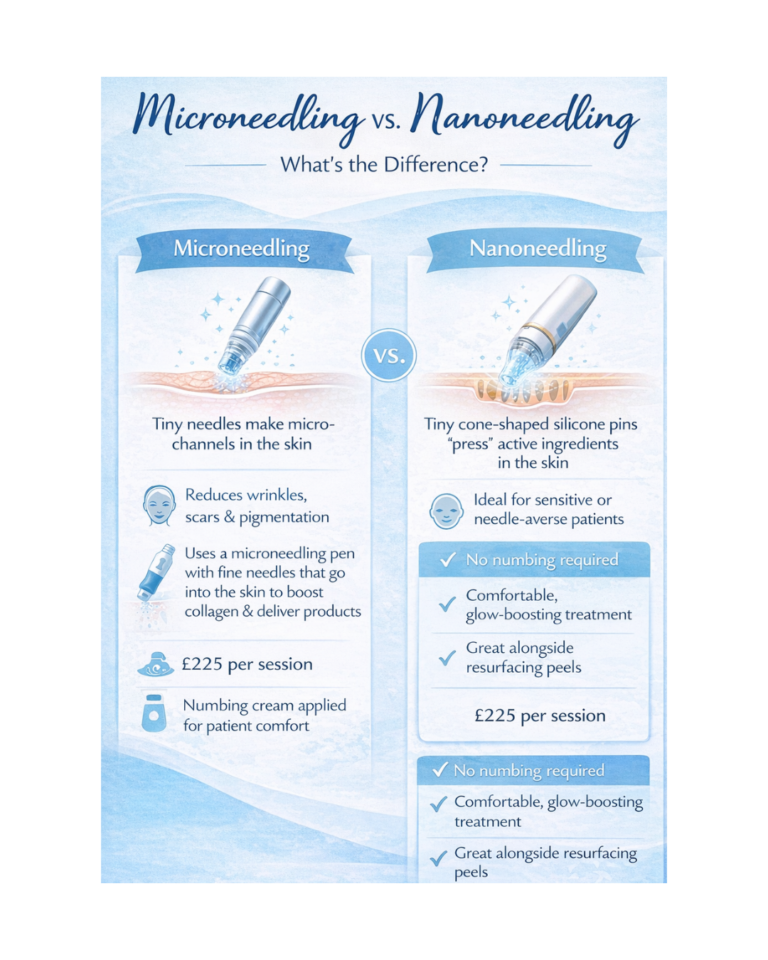
If you are noticing early texture changes, fine lines, dullness, or persistent breakouts, a doctor-led consultation can help establish whether a clinical treatment is the right next step. Microneedling can stimulate collagen and improve texture; skin boosters can address hydration and quality. Neither is essential — but both can be useful for the right patient.
7. Caring for Your Skin During and After Menopause
Once you reach menopause, the focus shifts from managing fluctuations to rebuilding and protecting at a deeper level. The principles below assume the unpredictable phase has passed and your hormones have settled at the post-menopausal baseline.
Prioritise hydration — properly
Look for richer, more emollient moisturisers. Hyaluronic acid serums can help, but they need to be layered under an occlusive moisturiser to lock the hydration in — otherwise they can actually draw moisture out of the skin in a dry environment. Your skin is losing water faster now, so the routine has to work harder to keep it in.
Step up your actives where tolerated
This is the time to use retinoids consistently, if your skin tolerates them. They are one of the most evidence-based ingredients for stimulating collagen and improving texture. Medical-grade retinoids — prescribed by a GP or aesthetics doctor — are often more effective than over-the-counter options, and at this stage the benefit is worth the increased upfront investment.
Consider skin boosters
Injectable hyaluronic acid skin boosters deliver deep hydration that topical products alone cannot achieve. They can help restore a sense of plumpness and radiance in skin that has become persistently dry. This is one of the treatments I recommend most often for post-menopausal patients who feel their skin is ‘thirsty’.
Explore collagen-stimulating treatments
Microneedling remains a good option, but post-menopausal skin may also benefit from more specifically collagen-stimulating treatments such as polynucleotides. These can help counteract the accelerated collagen loss that occurs in the years following menopause.
Anti-wrinkle injections, used subtly
For patients whose expression lines around the eyes or forehead have become more prominent as skin has thinned, anti-wrinkle injections remain one of the most evidence-based options for softening their appearance. The post-menopausal approach is more conservative than for younger patients — smaller doses, more selective placement — and the goal is a rested, natural appearance rather than a frozen one.
Do not neglect SPF — it matters more now
Post-menopausal skin is more vulnerable to UV damage, pigmentation, and accelerated ageing. SPF is protective, preventative, and essential. The same SPF 30+ broad-spectrum guidance applies as in perimenopause, but the consequences of skipping it are more visible now.
Speak to a GP if your concerns feel out of proportion
Persistent dryness, irritation, or skin changes that feel sudden or severe may warrant a medical review — not just an aesthetic one. As a GP-led clinic, we are well placed to help you distinguish between what is normal hormonal change and what may need further investigation or treatment.
8. What to Avoid at Both Stages
Regardless of where you are in your hormonal transition, some approaches are more likely to do harm than good. These are the patterns I see most often in patients whose skin is unhappy.
Over-exfoliation
Your skin’s barrier is already more fragile during perimenopause and beyond. Aggressive scrubs, daily acids, or frequent peels will only make things worse. Exfoliate gently and infrequently — or not at all if your skin is feeling reactive. Once or twice a week is plenty for most patients at this stage.
Layering too many actives at once
Retinol, vitamin C, AHAs, BHAs — these are all effective ingredients, but using them all together, especially on perimenopausal or menopausal skin, is a recipe for irritation. Simplify your routine and introduce one active at a time. If something stops working, take a step back — do not add another product on top.
Trend-driven products and DIY skincare
Social media skincare trends change weekly. Many are not backed by clinical evidence, and some contain ingredients that are too aggressive for hormonally changing skin. The same applies to homemade remedies — unregulated, unpredictable, and capable of causing irritation or infection. When your skin’s barrier is already more fragile, this is not the time to experiment with kitchen-table actives or social-media recipes.
Products designed for younger or oilier skin
Anti-acne ranges marketed to teenagers, mattifying products, or anything designed to strip oil will be too harsh for perimenopausal and menopausal skin. Your skin needs nourishment and support, not stripping. This includes ‘balancing’ cleansers that contain strong surfactants or heavy fragrance.
9. When to Seek Professional Advice
If your skin changes feel overwhelming, sudden, or simply not manageable with over-the-counter products, it is worth speaking to someone with medical expertise. There is a meaningful difference between a beauty consultation and a medical one — and at this stage of life, the medical perspective is often more valuable.
At Blue Bird Aesthetics I am a GP as well as an aesthetics doctor. This means that when you come for a consultation about hormonally changing skin, you are not just being assessed for which treatment to sell you. You are seeing someone who understands the hormonal transition from a clinical perspective and who can help you work out whether what you are experiencing is a normal part of perimenopause or menopause, or whether something else needs investigation.
I also offer evidence-based treatments tailored to your stage — from medical-grade skincare (including the AlumierMD range) to microneedling, skin boosters, polynucleotides, and anti-wrinkle injections. Every recommendation is made with your individual needs, your skin health, and your long-term wellbeing in mind. Sometimes the right answer is a treatment. Sometimes it is just a better routine and reassurance. Both are valid.
Curious about what might help your skin?
Book a calm, considered, commitment-free consultation with Dr Amber Halliday at Blue Bird Aesthetics. No pressure, no hard sell — just an honest conversation about your skin and your options.
→ Book a consultation at Blue Bird AestheticsFrequently Asked Questions
How do I know if my skin changes are due to perimenopause?
There is no single test, but the pattern is often recognisable: changes beginning in your late 30s or 40s, particularly if your periods have also become less predictable. New hormonal breakouts, increased sensitivity, occasional dryness, and a sense that products are no longer working as they used to — especially when these symptoms come and go — are all suggestive. A GP consultation can help establish the bigger picture.
Will my skin go back to normal after menopause?
It will stabilise — the unpredictability of perimenopause settles — but it will not return to the skin you had in your 30s. Lower oestrogen is the new baseline, which means thinner, drier skin overall. The good news is that this stable state is much easier to support with the right routine and selective in-clinic care than the constantly shifting target of perimenopause.
Should I be using stronger products now I am older?
Not necessarily — and often the answer is the opposite. Many women in perimenopause find that products they tolerated for years suddenly cause irritation. Strength is less important than appropriateness. The goal is products that support the barrier and address specific concerns without provoking inflammation. Medical-grade does not always mean stronger.
Is HRT going to fix my skin?
HRT can improve some skin parameters — hydration, elasticity, collagen content — because it restores some of the oestrogen the skin has lost. But the decision to take HRT belongs with your NHS GP and is based on your overall health, not just your skin. If you are already on HRT and your skin is still struggling, a topical and treatment-based approach can support what the HRT is doing systemically.
Are aesthetic treatments safe during perimenopause and menopause?
Yes, the same evidence-based treatments are safe and appropriate at these stages, provided they are delivered by a properly qualified practitioner who understands how your skin has changed. Expect longer recovery times for treatments like microneedling and peels than you may have had in your 30s, and a more conservative approach overall.
What is the single most important thing I can do for my skin at this stage?
Daily broad-spectrum SPF 30 or above. It is the most evidence-based, most cost-effective, and most underused step in most skincare routines. Hormonally changing skin is more vulnerable to UV damage, and UV damage accelerates every other change you are trying to manage. If you do nothing else, do this.
Can microneedling help post-menopausal skin?
Yes — microneedling stimulates the skin’s own collagen production, which directly addresses the accelerated collagen loss after menopause. Expect a more conservative treatment plan than for younger patients (lower needle depth, longer intervals between sessions) and a slightly slower recovery. The results, in the right patient, are well worth the patience.
I am suddenly breaking out in my mid-40s. Is this normal?
Yes, frustratingly. Hormonal breakouts in perimenopause are common and often appear along the jawline and chin. The instinct is to reach for the harsh teen-acne products, but these tend to make perimenopausal skin worse, not better. Gentle, targeted, low-concentration salicylic acid plus barrier support is usually a better starting point. Persistent cases benefit from a clinical conversation.
What is the best moisturiser for menopausal skin?
There is no single best product — but I would look for a moisturiser containing ceramides, fatty acids and humectants such as glycerin or hyaluronic acid, with an emollient or occlusive layer to lock moisture in. Avoid heavily fragranced products. The AlumierMD range has several formulations I recommend often; at consultation we discuss what is best for your specific skin.
Should I see my GP about my skin, or an aesthetics practitioner?
If your skin changes are sudden, severe, or accompanied by other symptoms — see your NHS GP first. If your skin is generally well but you want help working out what to do about hormonal changes, an aesthetics doctor who is also a GP (as I am) sits in a useful overlap between the two. The right answer is whichever clinician will give you an honest, evidence-based assessment.
The Takeaway
Perimenopause and menopause are not the same — and your skin will tell you that. Understanding the biology behind what is happening, and the difference between the two stages, is what allows you to care for your skin appropriately at each one. There is no one-size-fits-all approach. What matters is that you have the information, the support, and the options to make decisions that feel right for you.
If you are at the beginning of this transition, the priority is barrier protection, gentle introduction of actives, and getting SPF non-negotiable in your routine. If you are post-menopausal, the priority shifts to deeper hydration, collagen support, and selective in-clinic treatments where they add genuine value. Both stages reward patience, honesty, and a willingness to adapt.
You deserve to feel comfortable, confident, and cared for — not just in spite of the changes your body is going through, but because you understand them. If you would like to talk through what is happening with your skin, or are curious about what might help at your stage, I am here. No pressure. No hard sell. Just a calm, honest conversation with someone who cares about getting this right for you.
Ready for a calm, doctor-led conversation about your skin?
Book a calm, considered, commitment-free consultation with Dr Amber Halliday at Blue Bird Aesthetics, Worthing. Honest assessment, evidence-based options, no pressure to proceed.
→ Book a consultation at Blue Bird Aesthetics
Further Reading & Related Guides
| Skin support for hormonal change → The doctor’s guide to common skin concerns The drivers behind fine lines, pigmentation, dullness, texture and sensitivity → The ultimate guide to skin health A wider doctor-led approach to long-term skin quality |
| Treatments worth considering at each stage → Skin boosters at Blue Bird Aesthetics Deep injectable hydration — particularly helpful for post-menopausal dryness → Polynucleotides at Blue Bird Aesthetics Cellular regeneration for skin quality and collagen support → Microneedling at Blue Bird Aesthetics Collagen stimulation, texture and tone → Anti-wrinkle injections |
| Doctor-led care at Blue Bird Aesthetics → About Dr Amber Halliday GMC-registered GP, training, and clinical approach → Why choose a doctor for aesthetic treatments? |
Blue Bird Aesthetics · GP-Led Aesthetic Medicine, Worthing · www.bluebirdaesthetics.co.uk
Disclaimer: This guide is for educational purposes and does not replace a medical consultation. Individual suitability for any treatment can only be determined in person.
Blue Bird Aesthetics · GP-Led Aesthetic Medicine, Worthing · www.bluebirdaesthetics.co.uk
Disclaimer: This guide is for educational purposes and does not replace a medical consultation. Individual suitability for any treatment can only be determined in person.