What Is NeoGen Plasma? A Doctor’s Guide to Nitrogen Plasma Skin Regeneration
Not all skin regeneration is equal — and when it comes to meaningful, lasting change, the technology and the clinician behind it both matter| By Dr Amber Halliday, GP & Aesthetics Doctor | Blue Bird Aesthetics, Worthing | Updated 2026
TL;DR — Key Takeaways
✓ NeoGen uses controlled nitrogen plasma energy — not laser, not needles, not radiofrequency — to stimulate collagen remodelling without breaking the skin surface.
✓ Because the skin barrier stays intact, it’s regenerative rather than destructive — results look natural, not ‘treated’.
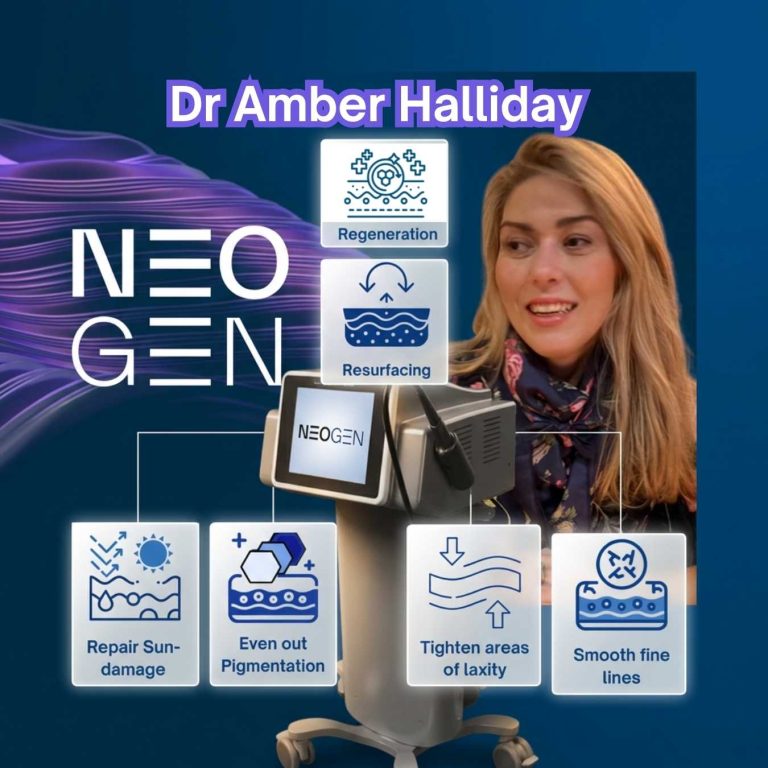
✓ It can treat sun damage, pigmentation, fine lines, early laxity, acne scarring, crepey texture and peri-orbital ageing.
✓ NeoGen is one of the only technologies that can safely treat eyelid skin.
✓ It is generally safer for a wider range of skin tones than ablative lasers, because it is not light-based.
✓ Results develop over 3–6 months and typically last 12–24 months.
✓ This is a medical-grade device — patient selection, energy settings and clinical oversight all determine the outcome.
✓ A doctor-led consultation is the right starting point — not a treatment menu.
If you’d like the full doctor‑led explanation, this is everything you need to know.
NeoGen is a medical-grade device that delivers controlled nitrogen plasma energy to the skin. It’s important to be precise about what this means, because “plasma” is a word used to describe several quite different technologies in aesthetics.
Who This Guide Is For
This article is written for anyone curious about NeoGen plasma — whether you’ve seen it mentioned online, been told about it by a friend, or are actively researching your options after trying other treatments.
It may be particularly useful if you:
- Have noticed changes in your skin quality that topical skincare alone isn’t addressing
- Are considering laser or RF treatments but feel uncertain about the downtime or risks
- Have skin concerns that involve delicate areas — particularly around the eyes
- Have a darker skin tone and are concerned about pigmentation risk with energy-based treatments
- Want to understand the science behind a treatment — not just the marketing
- Are looking for natural-looking improvement, not a dramatic or obvious result
By the end of this guide, you’ll have a clear, clinically grounded understanding of what NeoGen does, how it compares to alternatives, and whether it might be right for your skin. if you’d like to explore pricing, downtime and results in more detail, you can read the companion article here.
What Exactly Is NeoGen Plasma?
In 10 seconds: NeoGen converts nitrogen gas into plasma energy, which gently heats the deeper layers of the skin while keeping the surface intact. This triggers collagen remodelling and regeneration without the downtime of ablative lasers.
NeoGen is a medical-grade device that delivers controlled nitrogen plasma energy to the skin. It’s important to be precise about what this means, because “plasma” is a word used to describe several quite different technologies in aesthetics.
In physics, plasma is the fourth state of matter — distinct from solid, liquid and gas. It’s created when a gas is energised to the point where its electrons separate from their atoms, forming an ionised cloud. NeoGen uses nitrogen gas to create this plasma state and delivers it to the skin as a controlled, uniform thermal pulse.
What makes NeoGen different from lasers and other energy-based treatments is the nature of that energy delivery:
- It is not light-based — so it does not carry the same risk of pigmentation changes associated with laser energy in darker skin tones
- It does not use needles — so there are no channels, no micro-injuries, and no associated infection risk
- It does not break the skin surface — the outer layer (epidermis) remains intact while the thermal energy acts on the deeper layers (dermis) beneath
This last point is central to understanding why NeoGen produces the results it does. Because the skin barrier is preserved, the body’s response is regenerative — stimulating its own repair mechanisms — rather than healing from a wound.
“NeoGen isn’t about damaging the skin and hoping it heals better. It’s about delivering a precise thermal signal that the skin’s biology responds to with collagen remodelling, improved elasticity and better structural integrity.” — Dr Amber Halliday
The Science: What Happens in the Skin During NeoGen Treatment
Understanding the biology behind NeoGen helps to explain both why it works and why results take time to fully emerge.
The thermal cascade
When the nitrogen plasma pulse contacts the skin, it delivers a precise thermal effect to the treated area. This warmth — carefully calibrated to remain within a therapeutic range — triggers a cascade of biological responses in the dermal layer:
- Fibroblast activation: the cells responsible for producing collagen and elastin are stimulated to increase their output
- Collagen remodelling: existing collagen fibres begin to reorganise and tighten, and new collagen forms in the weeks and months that follow
- Elastin improvement: the proteins responsible for skin elasticity are regenerated alongside collagen
- Growth factor release: the thermal response triggers the release of growth factors that accelerate tissue renewal and repair
- Improved microcirculation: blood flow to the treated area increases, delivering oxygen and nutrients that support healing
Why results take 3–6 months to fully develop
New collagen is not formed overnight. The process of collagen synthesis, organisation and maturation is a gradual biological one — which is why the most significant visible changes from NeoGen treatment appear not in the days after treatment, but in the weeks and months that follow.
This also explains why NeoGen results look natural. Because the improvement is driven by your own biology, rather than by a procedure that alters your face acutely, the change is gradual, progressive and consistent with how your face actually moves and ages.
The two phases of visible change
Most patients notice two distinct phases of improvement:
Phase 1 (first 1–2 weeks): skin often appears brighter, more radiant and smoother in texture as the initial inflammatory response resolves. Some patients describe their skin looking “awake”.
Phase 2 (months 1–6): the deeper structural improvements emerge. Skin firms. Fine lines soften. Pigmentation fades. Peri-orbital skin tightens. These changes continue to develop for up to six months after treatment.
What NeoGen Can Improve
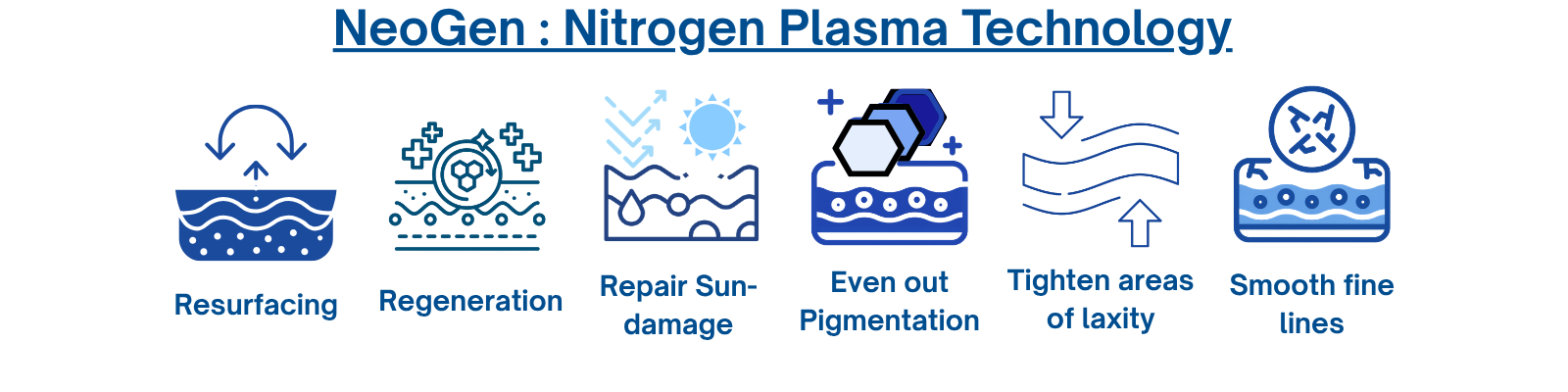
NeoGen is most effective for the gradual, cumulative changes that characterise naturally ageing skin. It’s not a dramatic resurfacing tool — it’s a regenerative one. The distinction matters. Because NeoGen is non‑ablative and not light‑based, it is generally suitable for a wider range of skin tones than many lasers.
Sun damage and pigmentation
Chronic sun exposure is the single biggest driver of accelerated skin ageing, and its effects show up as irregular pigmentation, uneven tone, a yellowed or greyish cast to the skin, and a gradual loss of clarity. NeoGen’s thermal energy encourages the turnover of pigmented cells and the renewal of the skin’s surface layer, which gradually improves tone and clarity over successive sessions.
Because NeoGen is not light-based, it does not selectively target melanin in the way that certain lasers do — which means it carries a lower risk of rebound pigmentation in patients with more melanin-rich skin.
Fine lines and early laxity
The firmness and smoothness of young skin depends on a dense, well-organised collagen scaffold. As this scaffold loosens with age, fine lines deepen and early laxity appears. NeoGen rebuilds this scaffold gradually, which is why results in this area tend to be among the most consistent. Patients often notice that fine lines soften and that their skin feels more supported and resilient.
For more significant laxity — particularly around the lower face and neck — a combination approach is often recommended. I may suggest NeoGen alongside skin boosters or polynucleotides to address both structural support and deep hydration simultaneously.
Crepey or thinning skin
Crepey skin — the thin, loosely gathered texture often seen on the neck, décolletage, under-eye area and backs of the hands — is one of the harder changes to address with topical skincare alone. NeoGen’s collagen-stimulating effect improves skin thickness and density over time, which reduces the crepey appearance and gives skin a more substantial, resilient feel.
Peri-orbital ageing and eyelid skin
The skin around and on the eyelids is among the thinnest on the body. It ages quickly, and treating it safely is challenging — many energy-based devices simply cannot be used in this area safely.
NeoGen is one of the few technologies that can treat eyelid skin directly. The precision of the nitrogen plasma energy, combined with the absence of light-based risk, makes it suitable for delicate peri-orbital work that would not be appropriate with ablative lasers or radiofrequency microneedling. This makes NeoGen a genuinely useful option for patients whose primary concern is eyelid skin thinning, hooding, or under-eye crepiness.
Acne scarring
Atrophic (pitted or depressed) acne scars form when the skin’s collagen scaffold is damaged during the inflammatory acne process. NeoGen’s collagen-remodelling effect can, over a course of treatments, improve the appearance of these scars by stimulating the gradual filling of depressed areas with new collagen.
Results vary depending on scar depth, age and skin type, and for deeper scarring I may recommend combining NeoGen with microneedling as part of a longer-term treatment plan.
Dullness and general skin quality
Not all patients present with a specific concern. Many simply feel that their skin looks tired, dull or no longer as vital as it once did — and want to address that without dramatic intervention. NeoGen’s effect on cell turnover, microcirculation and collagen production makes it well suited to this kind of general skin quality improvement.
NeoGen vs Lasers, RF Microneedling and Standard Microneedling
One of the most common questions I receive is: “How does NeoGen compare to [treatment I’ve seen advertised]?” The honest answer is that different technologies solve different problems, and the right choice depends on what your skin actually needs, not what’s most popular online.
Here’s a simple comparison:
| NeoGen Plasma | Ablative Laser | RF Microneedling (e.g. Morpheus8) | Microneedling |
Skin surface broken? | ✓ No | ✗ Yes | ✗ Yes (needle channels) | ✗ Yes (micro-channels) |
Needles used? | ✓ No | ✓ No | ✗ Yes | ✗ Yes |
Light/laser energy? | ✓ No | ✗ Yes | ✓ No | ✓ No |
Safe on eyelid skin? | ✓ Yes | ✗ Generally not | ✗ Generally not | ⚠️ With care |
Safe for darker skin tones? | ✓ Generally yes | ⚠️ Higher risk | ⚠️ Variable | ✓ Yes (with care) |
Typical downtime | 2–5 days bronzing | 5–14 days | 2–5 days | 24–48 hrs |
Collagen remodelling depth | Mid-to-deep dermis | Surface to mid | Mid dermis | Mid dermis |
Results timeline | 3–6 months | 2–4 months | 2–4 months | 4–8 weeks |
Results duration | 12–24 months | 12–18 months | 12–18 months | 6–12 months |
A note on ablative lasers
Ablative lasers — such as fractional CO2 or Erbium lasers — work by deliberately removing the surface of the skin and triggering wound healing. They can produce dramatic results in a single session, but they also carry significantly more risk: longer and more demanding recovery, higher risk of post-inflammatory pigmentation (particularly in darker skin tones), and greater potential for complications if not performed by an appropriately trained clinician.
For many patients, NeoGen offers a more comfortable and more predictable route to similar outcomes — with less downtime and a lower risk profile.
A note on RF microneedling (e.g. Morpheus8)
RF microneedling uses tiny needles combined with radiofrequency electrical energy to create controlled injury within the skin. It can produce good results, particularly for laxity and deep tissue remodelling. However, it is more physically invasive, often uncomfortable, and the uniformity of results depends significantly on consistent needle depth and technique. For patients who prefer to avoid needles, or who have concerns about downtime and bruising, NeoGen is a strong alternative.
Why I chose NeoGen for my clinic
| “I chose to introduce NeoGen at Blue Bird Aesthetics because it sits in a genuinely useful position in the treatment landscape. For patients who want real change without aggressive intervention, it delivers results that lasers and RF needling can’t always match for tolerability and skin safety.” — Dr Amber Halliday |
What Does NeoGen Treatment Actually Feel Like?
Setting realistic expectations around comfort is part of an honest consultation — so here is a clear account of what to expect at different energy levels.
Lower-energy treatments
At lower energy settings — typically used for a course of maintenance or first-line regenerative sessions — most patients describe NeoGen as a warm, prickling sensation. Some compare it to the feeling of briefly touching a hot object, but without pain. It’s noticeably warm, but very manageable for the vast majority of patients without any preparation.
Higher-energy treatments
At higher energy settings — used for more intensive single-session treatments targeting significant laxity, scarring or peri-orbital work — the sensation is more intense. Patients typically describe it as hot, with a stronger prickling quality. Appropriate preparation (topical anaesthesia, cooling between passes, managing treatment pace) makes this very tolerable, but I always discuss energy levels and patient experience in advance so there are no surprises.
Immediately after treatment
Skin will appear red and feel warm — similar in feel to moderate sunburn. There may be mild swelling, particularly around the eyes if that area has been treated. Over the following 2–5 days, skin often takes on a bronzed or slightly darkened appearance as the surface renews.
| What NeoGen does NOT involve Unlike ablative lasers, NeoGen does not produce oozing, open skin, or the need for dressings. Because the skin surface remains intact, there is no wound to manage. The recovery experience is more akin to a significant flush or sun response than to a traditional resurfacing procedure. |
You can find out more about the ethos and approach behind Blue Bird Aesthetics, and meet the doctor leading your care, on our about page.
Downtime, Recovery and Aftercare
One of the most practical questions patients ask is: “What will my skin look like, and what do I need to do?” Here’s a clear, realistic picture:
Days 1–2
Redness, warmth and mild swelling are normal and expected. Skin may feel tight. Most patients are comfortable going about daily activities, though some choose to take a day at home. Makeup is best avoided.
Days 3–5
The bronzing or darkening phase. Skin takes on a slightly deeper tone as the treated surface begins to shed and renew. This is a normal and expected part of the process, not a complication. The skin at this stage is best left alone — no picking, rubbing, or exfoliating.
Day 5 onwards
As the bronzed layer sheds naturally, fresher, brighter skin is revealed underneath. Most patients are comfortable in social and professional settings from around day 5–7, depending on the energy level used.
| Post-NeoGen Essentials SPF 50 every morning is non-negotiable — and for at least four weeks after treatment. The skin is more photosensitive during the renewal period, and UV exposure at this stage can interfere with the collagen remodelling process and increase the risk of pigmentation changes. Keep your routine simple: gentle cleanser, barrier moisturiser, SPF. Avoid strong actives (retinoids, acids, vitamin C) for at least two weeks. |
How Many NeoGen Sessions Will You Need?
NeoGen is offered at different energy levels, and the number of sessions required depends on both the energy setting used and what you’re trying to achieve.
Lower-energy courses (3–4 sessions)
A course of lower-energy treatments, spaced 4–6 weeks apart, is the most common approach for patients wanting progressive, maintenance-level improvement. Each session adds another layer of regenerative stimulus, and the cumulative effect over a course is significant. This approach is also more comfortable and involves less visible bronzing between sessions.
Higher-energy single sessions
For patients with more specific concerns — significant sun damage, early laxity, or peri-orbital changes — a single higher-energy session can achieve a more meaningful step-change in skin quality. The trade-off is a longer recovery window of 5–7 days of visible bronzing. Many patients choose one intensive session, followed by lower-energy maintenance sessions thereafter.
Maintenance
Most patients find that results last 12–24 months. An annual or biannual maintenance session helps sustain and build on the improvement, and many patients find their skin quality continues to improve with each treatment cycle.
The right approach for your skin will be worked out at consultation. There is no single NeoGen protocol that suits everyone. Book your consultation here →
How NeoGen Fits Into a Wider Skin Health Plan
NeoGen is not a treatment I recommend in isolation. The best outcomes come from a joined-up approach to skin health that combines the right treatments with medical-grade skincare and consistent sun protection. Here’s how NeoGen typically works alongside other treatments:
NeoGen + Skin Boosters
NeoGen stimulates collagen remodelling in the dermis. Skin Boosters (injectable hyaluronic acid treatments such as Profhilo or Juvederm Volite) improve deep hydration and support skin quality from the inside out. Together, they address the skin’s structural renewal and its moisture environment simultaneously — a powerful combination for patients with both laxity and dryness concerns.
NeoGen + Polynucleotides
Polynucleotides (PDRN) are regenerative injectables that stimulate fibroblast activity and tissue repair at a cellular level. Because they work through the same fibroblast pathway as NeoGen, the two treatments are genuinely synergistic. I often recommend polynucleotides alongside a NeoGen course for patients with more advanced skin quality concerns or significant peri-orbital ageing.
NeoGen + Microneedling
Microneedling works at a similar depth to NeoGen but through a different mechanism. It’s an excellent complement for patients who want ongoing collagen maintenance between NeoGen sessions, or for those whose primary concern is texture improvement alongside the regenerative benefits of NeoGen.
NeoGen + Resurfacing Peels
Resurfacing Peels address the surface of the skin — texture, dullness and mild pigmentation — at a more superficial level than NeoGen. Alternating peels and NeoGen sessions can address skin quality across multiple layers and timescales, making them a complementary pairing for patients who want comprehensive improvement.
NeoGen + Anti-Wrinkle Injections
Anti-wrinkle injections address dynamic movement-driven lines; NeoGen addresses the skin’s structural quality. The two work at completely different levels and complement each other well in a longer-term plan. Timing and sequencing will be discussed at your consultation.
Who Is — and Isn’t — Suitable for NeoGen
NeoGen is versatile, but it is not right for everyone. A proper clinical consultation is essential to assess suitability.
NeoGen may be a good option if you:
- Want meaningful improvement in skin quality without the downtime of ablative lasers
- Have concerns in delicate areas, particularly around the eyes
- Have a darker skin tone and are cautious about pigmentation risk with light-based treatments
- Have tried topical skincare and found it insufficient for the change you want
- Are looking for a treatment that supports your skin’s own biology rather than dramatically altering it
- Want proactive maintenance of your skin quality over time
NeoGen may not be appropriate if you have:
- Active skin infections or inflamed lesions in the treatment area
- Certain photosensitising medications or medical conditions
- A history of keloid scarring (which warrants careful assessment for any energy-based treatment)
- A recent course of isotretinoin — the standard guidance is to wait at least 6 months
- Very recent prolonged sun exposure or active tan
- Pregnancy
| ⚠️ NeoGen is a medical-grade device. Safe outcomes depend on appropriate patient selection, correct energy settings, and ongoing clinical oversight. It should only be performed by a qualified clinician with thorough understanding of skin biology, device parameters, and post-treatment management. |
Why Doctor-Led NeoGen Treatment Matters
NeoGen is an increasingly popular treatment, and it is beginning to appear in non-medical settings. This concerns me, and I want to explain why.
The device’s safety profile is one of its genuine strengths — but that profile is contingent on appropriate clinical use. The energy settings available on a NeoGen device span a wide range. At lower settings, the treatment is gentle and forgiving. At higher settings, it is a clinically significant intervention.
The difference between a safe, effective outcome and an adverse one lies in:
- Patient selection: identifying contraindications, medications, skin conditions and realistic expectations
- Energy calibration: matching the energy level to the patient’s skin type, concern, and tolerance
- Clinical judgement: knowing when to adjust, pause, or stop during treatment
- Post-treatment management: recognising and responding appropriately to any unexpected skin response
For a full breakdown of pricing, downtime and what to expect, you can read the companion article on NeoGen cost, results, side effects and recovery.
| “I’ll use NeoGen with the same clinical rigour I bring to any medical procedure. That means a thorough consultation, an honest conversation about what it can and can’t do, and clear guidance throughout recovery. That’s not a luxury in aesthetics. It’s a baseline.” — Dr Amber Halliday |
Frequently Asked Questions
Is NeoGen better than laser?
Better is not quite the right frame — it depends on what your skin needs. Ablative lasers can produce more dramatic results in certain contexts, but they carry more risk, more downtime, and are less suitable for a wide range of skin tones. NeoGen offers a more predictable, more comfortable route to meaningful skin quality improvement for many patients — particularly those who want change without aggressive intervention or extended recovery.
Is NeoGen plasma the same as plasma pen?
No — and this confusion is worth addressing clearly. Plasma pens are handheld devices that use electrical discharge to create plasma at the skin’s surface. They cause superficial burns and are often used for skin tags or very superficial skin tightening. NeoGen is a fundamentally different technology: it delivers controlled nitrogen plasma as a thermal pulse that stimulates deep dermal collagen remodelling without surface burning. They are not interchangeable.
Does NeoGen hurt?
Lower-energy NeoGen treatments are described by most patients as warm and prickling — noticeable, but very manageable. Higher-energy sessions feel hotter and more intense, but are tolerated well with appropriate preparation including topical anaesthesia and careful pacing during treatment. I always discuss comfort expectations in advance so there are no surprises.
How long is the downtime?
Lower-energy treatments involve redness and warmth for 24–48 hours, followed by 2–3 days of mild bronzing. Higher-energy sessions typically involve 5–7 days of more visible bronzing before the skin fully settles. Unlike ablative lasers, there is no oozing, no open skin and no need for dressings or wound care at any energy level.
How many sessions will I need?
This depends on your concern and the energy level we agree on at consultation. A course of 3–4 lower-energy sessions is the most common approach for progressive skin quality improvement. A single higher-energy session may achieve a more significant step-change for patients with specific concerns such as peri-orbital laxity or significant sun damage. Maintenance sessions every 12–24 months are typical thereafter.
Is NeoGen safe for darker skin tones?
NeoGen is generally safer for a wider range of skin tones than ablative lasers or intense pulsed light (IPL), because it is not light-based and does not selectively target melanin. That said, appropriate energy calibration based on Fitzpatrick skin type is still important, and a thorough consultation is essential for any patient whose skin is prone to pigmentation changes.
Can NeoGen treat the eyelids?
Yes — and this is one of NeoGen’s more significant clinical advantages. Eyelid skin is among the thinnest on the body and is often difficult to treat safely with other energy-based devices. NeoGen’s precision and non-ablative nature make it suitable for direct eyelid treatment, including hooding and under-eye crepiness. This must be performed with specialist technique and appropriate safety measures.
How long do results last?
Results typically last 12–24 months, depending on your skin type, the energy level used, how your skin ages naturally, and how well you support your skin with SPF and appropriate skincare between treatments. Annual or biannual maintenance sessions help sustain and build on the improvement.
Can I have NeoGen if I’m on certain medications?
Certain medications affect suitability for NeoGen treatment — including photosensitisers, blood thinners, and recent isotretinoin use. This is one of the key reasons a full medical consultation is required before treatment. Please bring a list of your current medications and supplements to your consultation.
What’s the difference between NeoGen and skin tightening treatments like Ultherapy?
Ultherapy uses focused ultrasound energy to target the deeper structural layer beneath the skin (the SMAS). It’s primarily a lifting treatment for significant laxity. NeoGen works at the level of the dermis — it’s a skin quality, collagen-remodelling and surface regeneration treatment rather than a structural lifting device. They address different concerns and can complement each other in a longer-term plan.
The Bottom Line
Ageing skin is not a flaw — it’s physiology. And while no treatment reverses the ageing process, the right intervention, performed well, can meaningfully support how your skin behaves, how it feels, and how it looks.
NeoGen sits in a genuinely useful position in the treatment landscape. It is evidence-based, regenerative, and — when properly performed — carries a favourable safety profile relative to the outcomes it achieves. For patients who want real, lasting change without aggressive intervention, it is one of the most clinically credible options currently available.
But technology is only part of the picture. The clinician who selects the right patients, calibrates the right energy, and guides them through recovery with appropriate medical oversight is what determines whether a treatment is safe, effective and worth it.
If you’re curious about NeoGen, the right starting point is a calm, honest conversation about your skin.
Your face deserves nothing less.
Ready to find out if NeoGen is right for you?
A consultation at Blue Bird Aesthetics is calm, considered and commitment-free. It’s a chance to understand your skin, your concerns, and whether NeoGen — or any other treatment — is genuinely the right fit.
Further Reading & Useful Links
Treatments at Blue Bird Aesthetics:
– Microneedling at Blue Bird Aesthetics
– Resurfacing Skin Peels in Worthing
– NeoGen Plasma Skin Regeneration in Worthing
– Anti-Wrinkle Injections in Worthing
Guides:
– Ultimate Aesthetics Guide — A Safe Doctor-Led Starting Point
– Anti-Wrinkle Injections in Worthing – A GP-led Guide
– Dermal Fillers at Blue Bird Aesthetics – Blog post
This article is for informational purposes. It does not constitute medical advice. Always consult a qualified medical professional before undertaking any aesthetic treatment.
Blue Bird Aesthetics

Doctor‑led medical aesthetics clinic in Worthing, West Sussex. Focused on enhancing natural beauty, improving overall skin quality and adhering to clinically safe treatment pathways.
Unsure where to start? Try our doctor-designed Treatment Finder Quiz


10 Comments