Aesthetic Treatments for Men: A Doctor’s Guide to What’s Different
Thicker skin, stronger muscles, double the doses, and complete discretion — treating men well requires a different approach.
By Dr Amber Halliday, MRCGP MBBS BSc (Hons) — GP & Aesthetics Doctor | Blue Bird Aesthetics, Worthing | Updated 2026
TL;DR — Key Takeaways
Short on time? Here’s the summary:
✓ Men’s skin is anatomically different — thicker, with stronger muscles that require higher treatment doses.
✓ Many male patients have no skincare history, which is the first thing to address before in-clinic treatment.
✓ Men typically need significantly more anti-wrinkle treatment than women for the same areas, due to muscle bulk.
✓ The primary concern is almost always discretion — looking better, not looked-after.
✓ Under-eye treatment with Sunekos is the most common request — addressing the depleted, tired look without adding volume.
✓ Masculinisation is about structure, not softening — a very different aesthetic goal to most female patients.
Men’s Skin Is Different — and That Changes the Treatment
Treating men is not simply treating women with different product quantities. The anatomy is different, the goals are different, and the conversation often starts from a different place.
The most striking physical difference is skin thickness. Some male patients have remarkably dense, thick skin — what is sometimes called rhino skin in dermatology circles. That thickness affects how treatments behave: needles meet more resistance, product integrates differently, and results may need a different approach than with finer skin.
The Skincare Gap
Most male patients who come to me have little or no history of skincare — no SPF routine, no moisturiser, often just soap and water for decades. That is not a criticism; it is a reflection of how skincare has historically been marketed and what men have been told they need.
But it means that the first conversation is often not about in-clinic treatment at all. It is about establishing a basic home routine — a decent cleanser, a moisturiser, and a daily SPF — because any clinical treatment is only as lasting as the skin quality around it. You cannot microneedle or treat skin that is chronically sun-damaged and under-supported and expect the same results as skin that has been properly looked after.
Looking after your skin is not vanity. It is looking after your largest organ — exactly as you would look after your heart, your joints, your diet.
— Dr Amber Halliday
Why Men Need Higher Doses of Anti-Wrinkle Treatment
When a male patient has anti-wrinkle injections, they typically need roughly double the number of units compared to a woman treating the same area. The reason is muscle bulk — not the density of the skin above, but the size and strength of the muscles below.
Male facial muscles are generally larger and stronger. More product is needed to achieve the same reduction in movement. This is straightforwardly physiological, not a commercial convenience, and it is worth knowing before you budget for treatment.
A note on masculinisation
There is an important distinction between treating expression lines and feminising the face. Male aesthetic goals often include preserving strong features — jawline, brow projection, definition — not softening them. Getting this balance right requires assessment, not a standard template.
The Male Face: Different Ideals
Feminine facial aesthetics tend towards a V-shaped structure — the most anterior projection (the furthest point forward) sitting between the tip of the chin and the cheekbones, with a narrowing jaw. Male aesthetics are typically different: a broader, squarer chin, stronger jawline, and heavier brow projection.
When I am assessing a male patient for structural work, I am working with these proportions rather than against them. The goal is a face that looks more defined and rested, not one that has been feminised by an aesthetic designed for a different face.
What Men Actually Worry About
The primary concern, far more consistently than with female patients, is that people will know they have had something done. There is still a degree of stigma around male aesthetic treatment, and many patients are very particular about discretion — they want to look better, not looked-after.
I find this quietly moving. Men are looking after themselves in exactly the same way that women have been encouraged to for years. There is nothing to be self-conscious about.
The Most Common Request: Under-Eyes
The under-eye area is consistently the most common concern I see in male patients. The depleted, shadowed look around the eyes — the one that makes someone look permanently tired, or as though they have been entertaining clients and sleeping poorly — responds beautifully to Sunekos.
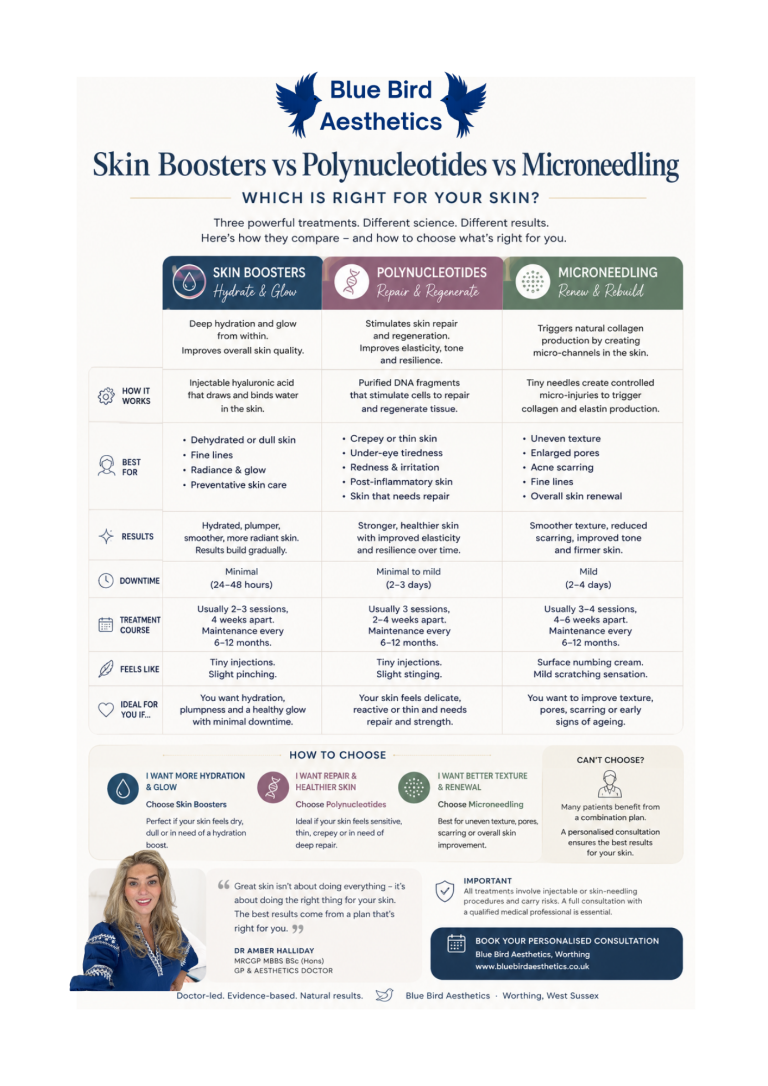
Sunekos is a skin booster that rehydrates and improves the quality of the skin without adding structural volume. It is ideal for this kind of concern in male patients because the effect is natural — fresher and more rested — rather than visibly treated. Exactly what most patients are asking for.
Ready to talk it through?
Book a calm, considered, commitment-free consultation in Worthing.
A consultation for men is exactly the same: calm, no pressure, no judgement.
Further Reading & Related Treatments
- Anti-Wrinkle Injections: How they Work
- Profhilo & Skin Boosters: What They Really Do
- Is Medical-Grade Skincare Worth It?
- The Ultimate Guide to Aesthetic Treatments in Worthing
Frequently Asked Questions
Do men need more anti-wrinkle treatment than women?
Typically yes — roughly double the units for the same area, due to greater muscle bulk. This is physiological, not arbitrary.
Will I look like I have had something done?
Not with conservative, doctor-led treatment. The goal is looking more rested and refreshed, not treated. Discretion is something I take seriously.
Is skincare something you recommend before treatment?
Yes, for most male patients. Establishing a basic routine — cleanser, moisturiser, SPF — dramatically improves the results and longevity of any in-clinic treatment.
What is masculinisation?
It is a treatment approach that enhances typically masculine facial features — stronger jaw, heavier brow projection, broader chin — rather than applying a standard aesthetic framework designed for female faces.
What is the best treatment for tired-looking eyes in men?
Sunekos is my most common recommendation — a skin booster that rehydrates the under-eye area and improves skin quality without adding volume. The result looks natural and rested.
Is there any treatment men should avoid?
I would be cautious about heavy lip augmentation or any structural treatment that softens male features rather than enhancing them. The treatment must match the goal.