Anti-Wrinkle Injections in Worthing: What to Expect and How to Know If They’re Right for You
Who benefits, who doesn’t, realistic results, and the decision-making conversation I have in clinic every day.
By Dr Amber Halliday, MRCGP MBBS BSc (Hons) — GP & Aesthetics Doctor | Blue Bird Aesthetics, Worthing | Updated 2026
TL;DR — Key Takeaways
Short on time? Here’s the summary:
✓ Anti-wrinkle injections work best for dynamic expression lines — those visible during movement rather than at rest.
✓ The frozen face look is a product of excessive dosing, not of the treatment itself — conservative technique preserves natural movement.
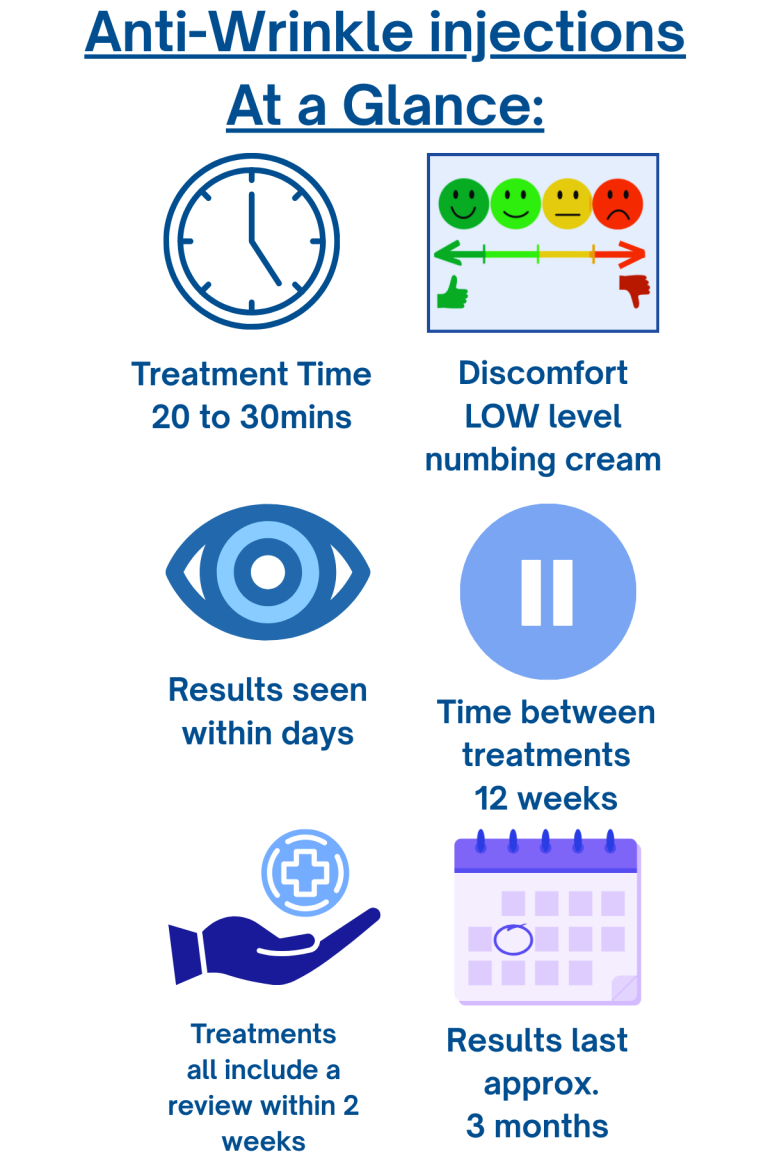
✓ Results take 10–14 days to fully appear; a review at 2–4 weeks allows for fine-tuning.
✓ They require maintenance every 3–4 months — this is a commitment, not a one-time procedure.
✓ If your main concern is skin quality, laxity or deep resting lines, different treatments are likely to serve you better.
Looking for pricing and booking information?
This article is a clinical guide to Anti-wrinkle injections. For prices,
packages and to book a consultation, visit our
Anti-Wrinkle injections treatment page
.
The Question Behind the Question
Most people who come to my clinic for a consultation about anti-wrinkle injections have already decided they want them. The real question — the one I spend the consultation answering — is whether they are right for you, at this stage, for this concern.
That distinction matters enormously. Anti-wrinkle injections are one of the most effective tools in aesthetics — for the concerns they are designed to address. For other concerns, they are the wrong tool entirely, and knowing which is which is what a doctor-led consultation is for.
Who Benefits — The Honest Criteria
Anti-wrinkle injections produce their most noticeable results in patients with active dynamic lines — the lines formed by facial movement, such as forehead lines when raising the brows, frown lines between the eyes, and crow’s feet at the outer corners. Patients also benefit for:
- Jaw clenching and teeth grinding (bruxism) — masseter treatment can reduce the force of clenching and, over time, slim a jaw widened by muscle hypertrophy.
- Excessive underarm sweating (hyperhidrosis) — botulinum toxin is one of the most effective and long-lasting treatments available.
- Downturned mouth corners, gummy smile, lip flip — smaller areas where precise treatment creates meaningful change.
When It Is Not the Right Treatment
I turn patients away from anti-wrinkle injections more often than they expect. Not because I am being overcautious, but because sending someone in the wrong direction wastes their money and delays the result they truly need.
- Deep resting lines — lines fully visible even when your face is completely relaxed need resurfacing or skin-quality treatment, not muscle relaxation.
- Significant skin laxity or early jowling — a structural tissue concern that botulinum toxin cannot address. NeoGen Plasma or regenerative treatment is the appropriate conversation.
- Patients wanting zero facial movement — not a goal I work towards. It produces an unnatural result and often leads to regret.
- Pregnancy and breastfeeding — botulinum toxin is not recommended during either.
If the treatment is not right for you, I will always say so and explain what I think would help instead. That is what a doctor-led consultation looks like.
The Prevention Conversation — An Honest View
Younger patients sometimes ask about anti-wrinkle injections for prevention — the idea that treating lines early stops them forming. The evidence here is nuanced.
In your 20s and very early 30s: most people are better served by investing in excellent SPF (daily, without exception) and medical-grade skincare than by starting injectable treatment. The skin’s own repair is vigorous and the lines forming now often settle.
From the mid-30s onwards: if you are starting to see lines that persist a little at rest, or that deepen noticeably, there is a reasonable argument for early, conservative treatment to slow their progression. But each case is individual.
There is no universal answer to when to start. Consultation — not a price list — is the honest starting point.
— Dr Amber Halliday
What Results Realistically Look Like
The most accurate thing I can tell you is this: done well, most people simply hear “you look well.” That is the result. Not “what have you had done?” but “you look rested.”
What changes specifically: lines visible during movement soften noticeably, sometimes dramatically. The face looks more relaxed. Skin may appear smoother because it is creasing less. The brow position can open slightly with careful treatment of the frown area.
The frozen face is not an inevitable outcome — it is the result of excessive dosing and poor technique. With conservative treatment and regular review, natural movement is preserved.
How Long It Takes to Work — and How Long It Lasts
Onset begins at 3–5 days and full effect is usually visible by 10–14 days. This is important for event planning — allow at least four to six weeks for a first treatment before an important occasion.
Duration is typically 3–4 months, occasionally up to five. Individual variation exists and is driven by metabolism, muscle mass, and the dose used. Most patients find a rhythm and book their next appointment when movement returns, rather than waiting for lines to return fully.
The review appointment at 2–4 weeks is part of the treatment, not a bonus. It is the opportunity to assess the result, address any asymmetry, and add a small top-up if one area needs more.
Prices in Worthing — What to Budget
At Blue Bird Aesthetics, anti-wrinkle injections are priced by area and can be found on my website’s treatment menu.
One “area” means: forehead lines, or frown lines, or crow’s feet — each counts as one. Most patients treat two or three areas in a single session for a balanced result.
A note on price
Please be thoughtful about pursuing the cheapest option. Botulinum toxin is a prescription-only medicine. The price you pay should reflect qualified prescribing, proper assessment, emergency preparedness and a clinician who can manage a complication if one arises. Here is how to assess a clinic.
Timing Around Events
For a first treatment: allow 4–6 weeks minimum before an important occasion. This gives time for the result to appear and for any fine-tuning at the review.
For ongoing maintenance: once you know how you respond and your ideal schedule, top-ups can usually be timed closer to events if you have an established relationship with your clinician.
What the Consultation Involves
My consultations take anywhere from 45mins to one hour. We discuss your concerns, your medical history, your goals, and the treatment options that suit you — including those that might serve you better than anti-wrinkle injections. You will not be rushed, and there is no pressure to proceed on the day.
There is no pressure, no deposit required to attend, and no obligation to proceed. Many patients leave with a plan rather than a treatment, and return when they are ready.
Ready to talk it through?
Book a calm, considered, commitment-free consultation in Worthing.
One-hour consultations with a GP, no pressure, no deposit.
Further Reading & Related Treatments
- How Anti-Wrinkle Injections Work — the mechanism explained
- Why Choose a Doctor for Anti-Wrinkle Injections and Fillers?
- Dermal Fillers in Worthing — if volume is also a concern
- NeoGen Plasma — for skin laxity and quality that injectables cannot address
- The Ultimate Guide to Aesthetic Treatments in Worthing
Frequently Asked Questions
Can I have all three areas treated at once?
Yes, and for many patients this gives a more natural, balanced result than treating one area in isolation. A consultation establishes which approach suits your face.
Will it affect my ability to look surprised, angry or emotional?
With conservative dosing, no. The goal is softened movement, not absent movement. You retain the full range of expression — with less of the creasing.
How soon can I have it again?
I recommend a minimum of 12 weeks between treatments. Treating too frequently does not extend the effect and risks cumulative over-treatment.
What if I am unhappy with the result?
The review appointment at 2–4 weeks is specifically for this. Most concerns — slight asymmetry, an area that needs more — can be addressed then. The effect also wears off, so nothing is permanent.
What should I avoid before my appointment?
Avoid alcohol 24 hours before. If you take blood-thinning medications or supplements (aspirin, fish oil), discuss this at consultation. No retinoids on the day. Come with a clean face if possible.