Why SPF Matters More After 40: A Doctor’s Guide to Sun, Pigmentation and Coastal Living
Why the same sun does more damage after 40 — the SPF myth that wastes money, and the sunscreen I recommend.
By Dr Amber Halliday, MRCGP MBBS BSc (Hons) — GP & Aesthetics Doctor | Blue Bird Aesthetics, Worthing | Updated 2026
Sunscreen is the most powerful anti-ageing product I can recommend, and the least glamorous. It matters at every age — but after 40 it stops being optional, because the same hour in the sun does more damage than it did at 25.
Living on the Sussex coast makes this more relevant, not less. Here is what changes in your skin, the SPF myth that wastes money, and the type of sunscreen I prefer.
Sunscreen is the most effective anti-ageing product I can recommend — and the least exciting. After 40, it is no longer optional.
— Dr Amber Halliday
Who This Guide Is For
- Anyone over 40 wondering whether their sun protection is good enough.
- People confused by SPF numbers and ‘physical vs chemical’ labels.
- Coastal and outdoor-loving Worthing residents.
- Anyone investing in skin treatments who wants to protect that investment.
TL;DR — Key Takeaways
Short on time? Here’s the summary:
✓ After 40 your skin repairs UV damage less well, so the same exposure does more harm.
✓ Falling oestrogen reduces fibroblast activity and slows skin repair.
✓ SPF strength is not the whole story — the gap between factor 30 and 50 is small; how you use it matters more.
✓ I prefer a physical (mineral) sunscreen with zinc or titanium, especially for sensitive or reactive skin.
✓ Coastal life adds sun, wind and dryness — protection needs to be daily and year-round.
✓ Good SPF protects your skin and every penny you spend on treatments.
1. Why your skin is more vulnerable after 40
Two things change. First, the effects of sun exposure are cumulative — decades of oxidative stress add up, and after 40 your skin is simply more prone to UV damage. Second, as oestrogen falls, fibroblast activity drops, and fibroblasts are the cells that repair and rebuild your skin. So you are taking more damage and repairing it less well at the same time.
2. The SPF myth that wastes money
The most common myth I correct is that the number is all that matters. It is not. The difference in damaging rays blocked between a factor 30 and a factor 50 is small — a couple of percent — and is easily wiped out by applying too little or not reapplying. A factor you will wear every day beats a higher number you skip.
What matters more than the number
Wearing it daily, using enough, and reapplying. A sunscreen used properly at factor 30 protects you better than a higher factor used sparingly.
3. Physical or chemical — and why I lean physical
Chemical filters absorb UV and change how it interacts with the skin; physical (mineral) filters containing zinc or titanium sit on the surface and reflect and scatter much of it away. I tend to prefer a physical sunscreen, particularly for reactive, rosacea-prone or sensitive skin, because it is gentler and reflects rather than absorbs the energy. Chemical sunscreens are not “bad” — but a good mineral SPF is my usual recommendation.
4. The Worthing factor: sun, wind and dryness
Coastal skin takes a particular battering. Alongside sun, there is wind and a surprising amount of dryness, and on a skin analysis I often see more sun damage, more dehydration, and more pigment sitting below the surface than people expect. None of it is a reason to leave the coast — it is a reason to protect your skin while you enjoy it.
We live by the sea for the light and the air. The same sun and wind we love are quietly ageing our skin every single day.
— Dr Amber Halliday
5. How to use it well
A sun-protection routine that sticks:
- Wear a broad-spectrum SPF every day, all year — not just on holiday.
- Use enough, and reapply through the day if you are outdoors.
- Choose a physical/mineral SPF (zinc or titanium) if your skin is sensitive or reactive.
- Make it a habit — keep it where you will see it, the way some people keep it by the toothbrush.
- A good medical-grade SPF is one of the few products truly worth the money.
6. What you are really protecting
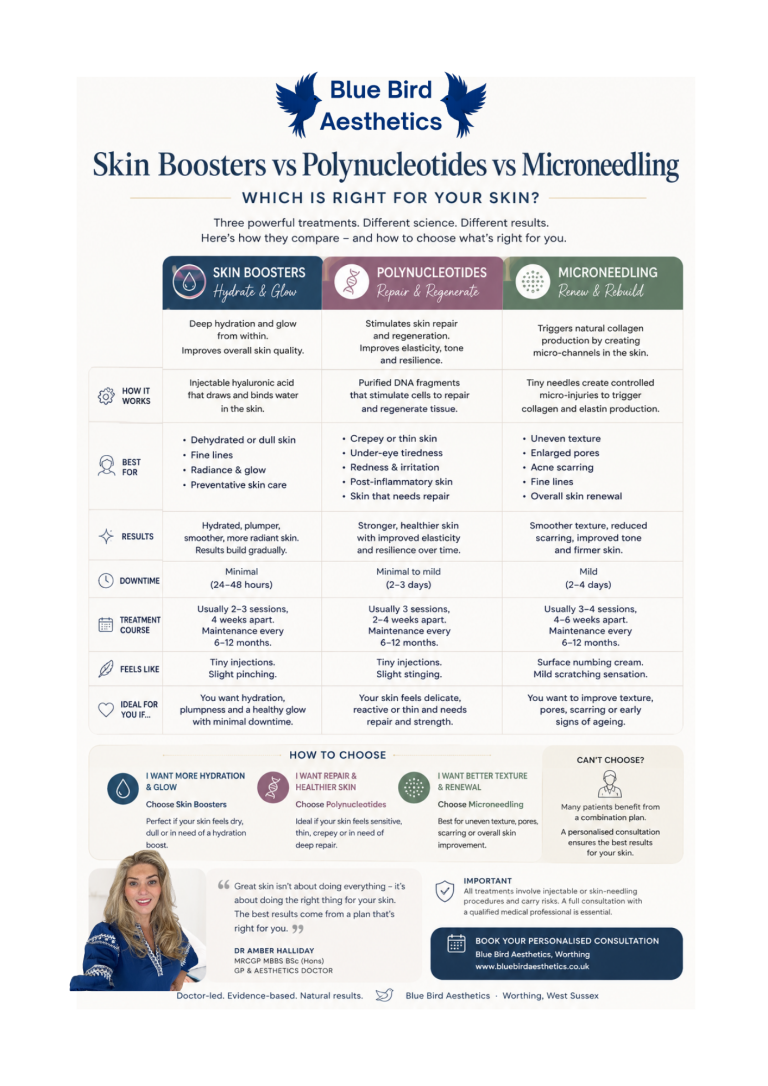
Daily SPF is not only about wrinkles. It is your best defence against the pigmentation that is so hard to treat once it appears, and it protects the results of every peel, microneedling course or skin booster you invest in. If your skincare has a foundation, this is it. My complete guide to skin treatments puts it in context.
Frequently Asked Questions
Is a higher SPF always better?
Not meaningfully. The difference between factor 30 and 50 in damaging rays blocked is only a couple of percent. Applying enough and reapplying matters far more than the number.
Physical or chemical sunscreen — which is better?
Both work. I usually prefer a physical (mineral) SPF with zinc or titanium, especially for sensitive or rosacea-prone skin, because it reflects UV rather than absorbing and processing it.
Do I need SPF in winter or on cloudy days?
Yes. UVA, the ageing wavelength, is present year-round and passes through cloud and glass. Daily, all-year protection is the goal.
How much should I use and how often?
More than most people think — roughly two finger-lengths for the face and neck — and reapply through the day if you are outside.
Does SPF prevent pigmentation?
It is the single most important step in preventing and managing pigmentation, because UV is the main trigger.
What SPF is best for sensitive or rosacea-prone skin?
A physical/mineral sunscreen with zinc or titanium, which tends to be gentler and less likely to irritate.
Is some sun ever good for me?
Sensible, brief exposure has a role in vitamin D, but that does not require unprotected sunbathing. Protect your face and the areas that show ageing most.
Does the SPF in my moisturiser or make-up count?
It helps, but the amount applied is usually too small to rely on by itself. A dedicated SPF layer is better.
The Takeaway
If you do one thing for your skin after 40, make it daily sun protection. Your skin repairs less than it once did, so prevention is worth far more than cure — and on the coast, where we get more sun and wind than we admit, it matters even more.
Choose a sunscreen you will wear every day, ideally a physical one, and use it properly. It is the least glamorous and most effective step in skincare.
If you would like your skin assessed and a routine matched to it, that is what a consultation is for.
Ready to talk it through?
Book a calm, considered, commitment-free consultation in Worthing.
We’ll assess your skin, including sun and pigment damage, and build a simple routine to protect it — no pressure to buy.