Liquid Microneedling: Spicule Therapy Explained
By Dr Amber Halliday, MRCGP MBBS BSc (Hons) | Blue Bird Aesthetics, Worthing
✓ Medically reviewed by Dr Amber Halliday, MRCGP MBBS BSc (Hons)
- Liquid microneedling uses microscopic sea-sponge spicules to create controlled micro-channels in the skin — no needles, no device.
- It is applied as a treatment in clinic and continues working over the following days as the skin sheds.
- Expect a tingling sensation, two to four days of dryness and flaking, then a visible improvement in texture and clarity.
- It suits congestion, dullness, rough texture and mild scarring. It is not a substitute for medical microneedling on deeper scarring.
- Liquid microneedling at Blue Bird Aesthetics is £225. Consultations are free.
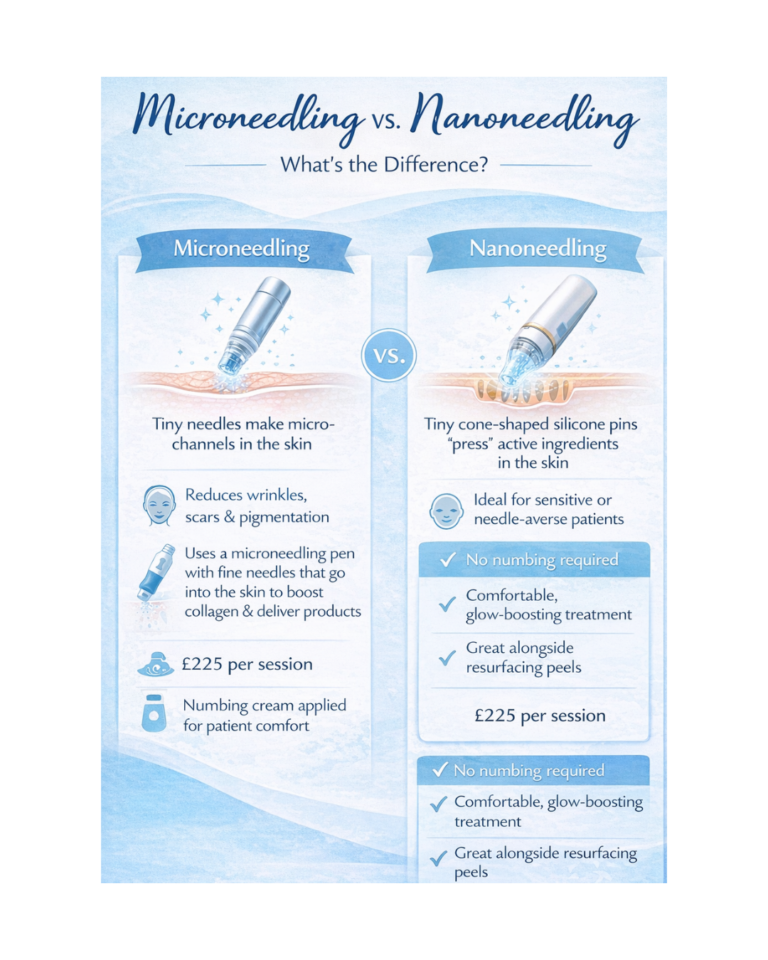
Liquid microneedling is listed alongside traditional micro- and nanoneedling on the microneedling treatment page.
What liquid microneedling is
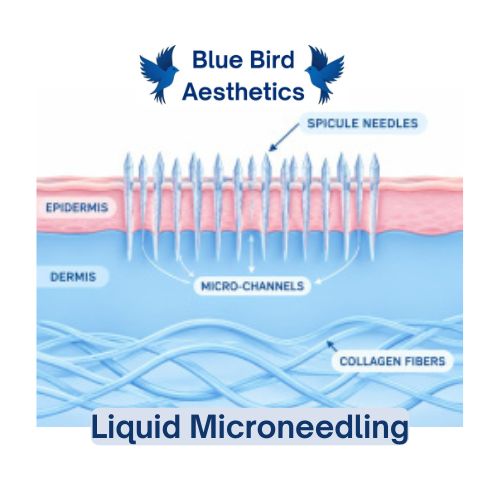
Liquid microneedling — also called spicule therapy — achieves something close to the effect of needling without a needle or a device. It uses spicules: microscopic, naturally occurring silica structures harvested from freshwater sponges, suspended in a treatment base and massaged into the skin.
Each spicule is a fine, rigid spike a fraction of a millimetre long. Worked into the skin, they embed in the upper layers and create thousands of tiny channels. Those channels do two things: they trigger the skin’s own repair response, and they allow active ingredients applied alongside them to penetrate far more effectively than they would through intact skin.
Very few clinics in the UK offer this, which is partly why it is unfamiliar. It is well established in Korean and Japanese aesthetic practice, where it has been used for considerably longer than it has here.
How it differs from traditional microneedling
Medical microneedling uses a motorised device with sterile needles to create channels at a controlled, adjustable depth — typically 0.5mm to 2.5mm, reaching well into the dermis. That depth is what makes it effective for structural problems such as atrophic acne scarring.
Liquid microneedling works much more superficially, in the epidermis and the very upper dermis. It cannot reach the depth required to remodel established scar tissue. What it does instead is accelerate turnover across the whole surface, decongest pores, and deliver actives efficiently.
The practical differences that matter to you:
- No device, no needles. Some people find this significantly less daunting.
- The treatment continues after you leave. The spicules remain in the skin and keep working for two to three days, which is why the visible response is delayed rather than immediate.
- Different downtime pattern. Microneedling gives redness on the day that settles quickly. Liquid microneedling gives little on the day, then dryness and flaking on days two to four.
- Lower depth, lower ceiling. It will not do what a course of medical microneedling does for scarring.
What it suits
The concern pages for skin texture and enlarged pores and dull or dehydrated skin cover the full range of options for these concerns.
- Congested, dull or rough-textured skin
- Enlarged-looking pores and general lack of clarity
- Uneven tone and post-inflammatory marks once active inflammation has settled
- Mild superficial scarring and textural irregularity
- Patients who want a meaningful reset without a device-based treatment
- Skin that needs improving before a course of something stronger
What it does not suit
- Active inflammatory acne. Working spicules into inflamed skin will aggravate it. Acne needs controlling first.
- Deep or atrophic acne scarring. Medical microneedling or NeoGen are the right tools — see the acne scarring concern page.
- Active rosacea or a compromised barrier. This is a deliberately disruptive treatment and a damaged barrier will not tolerate it. See skin barrier repair and rosacea first.
- Anyone unable to accommodate a few days of visible flaking. Timing matters — do not book this in the week before an event. If you are working towards a date, see wedding-ready skin or camera-ready skin for sensible timelines.
- Pregnancy, breastfeeding, active skin infection or recent isotretinoin use.
What to expect, day by day
During treatment
The skin is cleansed and the spicule preparation is massaged in for several minutes. You will feel a distinct prickling or tingling sensation that builds as the spicules embed. It is not painful but it is unmistakeable — most people describe it as unusual rather than uncomfortable. The treatment takes around 45 minutes.
Day one
Mild warmth and slight redness. Skin may feel tight. Most people look essentially normal and go about their day.
Days two to four
This is the active phase. Skin becomes dry and begins to flake, sometimes noticeably. Do not pick, exfoliate or attempt to speed it up — the shedding is the treatment working, and interfering with it is the main cause of a poor outcome. Use a bland moisturiser and SPF.
Days five to seven
Flaking resolves and the new surface is revealed. This is when the improvement in texture, clarity and smoothness becomes visible.
No retinoids, acids or physical exfoliants for seven days. Daily SPF 50 without exception — freshly resurfaced skin is more vulnerable to pigmentation. Keep the barrier supported with a simple moisturiser. And resist the urge to help the flaking along.
How many sessions
A single session produces a visible result. For a meaningful change in congestion, texture or tone, a course of three spaced four to six weeks apart is more realistic. Some patients then use it as a periodic reset two or three times a year.
Where it fits alongside everything else is worth discussing at consultation — it is often used as preparation before a course of something stronger, or as maintenance between more substantial treatments. The treatment ladder sets out how the tiers relate.
Frequently Asked Questions
Does it hurt?
No, but it is a strong sensation. The prickling builds over the first few minutes as the spicules embed and then settles. Most people find it strange rather than painful.
How bad is the flaking?
Variable. Some people get light dryness, others shed visibly for two or three days. It is not predictable in advance, so plan around it rather than hoping for the lighter version.
Is it better than microneedling?
Neither is better; they do different jobs. Liquid microneedling is superior for congestion, turnover and surface clarity. Medical microneedling is superior for anything structural, particularly scarring. The right answer depends entirely on what you are treating.
Can I have it with sensitive skin?
Sensitivity is not an automatic exclusion, but a genuinely compromised barrier is. I assess this at consultation. If your barrier needs work first, that is where we start.
Can I wear makeup afterwards?
Avoid it for 24 hours. During the flaking phase makeup tends to sit poorly on shedding skin, so most people prefer to go without or keep it minimal.
Is it suitable for all skin tones?
Yes. It uses no heat and no light, so the risk of post-inflammatory pigmentation that accompanies energy-based devices does not apply in the same way. Diligent SPF afterwards remains essential.
Ready to look at pricing and book? Liquid microneedling is listed on the microneedling treatment page alongside traditional micro- and nanoneedling. For chemical resurfacing see the resurfacing treatments page.
Related reading: Microneedling — treatment page · How Microneedling Works · Microneedling in Worthing: What It Achieves · Microneedling for Acne Scarring · Skin Peels: A Doctor’s Guide · Your Skin Barrier and How to Repair It
Consultations at Blue Bird Aesthetics are free. Glowday takes a £75 card authorisation when you book — this is not charged, and applies only to late cancellations or non-attendance. Treatment prices are confirmed at consultation and paid in clinic afterwards.
Book via Glowday · How booking works
This article is for information only and does not constitute medical advice. Individual suitability can only be assessed in person. All treatments at Blue Bird Aesthetics are subject to medical consultation and go ahead only when clinically appropriate.