Polynucleotides for Under-Eyes: What They Can (and Can’t) Do
Why the best under-eye results often come from rebuilding the skin — not filling it — and how to know which you need.
By Dr Amber Halliday, MRCGP MBBS BSc (Hons) — GP & Aesthetics Doctor | Blue Bird Aesthetics, Worthing | Updated 2026
The under-eye is one of the areas people most want to improve and one of the easiest to get wrong. Polynucleotides — I use Plinest — are one of my favourite tools here, because they work by improving the quality of the skin itself rather than filling a hollow. But they are not right for every under-eye, and knowing the difference matters.
Polynucleotides do not fill the under-eye — they rebuild the quality of the skin there. That is a different, and often better, way to look less tired.
— Dr Amber Halliday
Who This Guide Is For
- Anyone with dark, thin or tired-looking under-eyes wondering what helps.
- People who have been told they need tear trough filler and want an alternative.
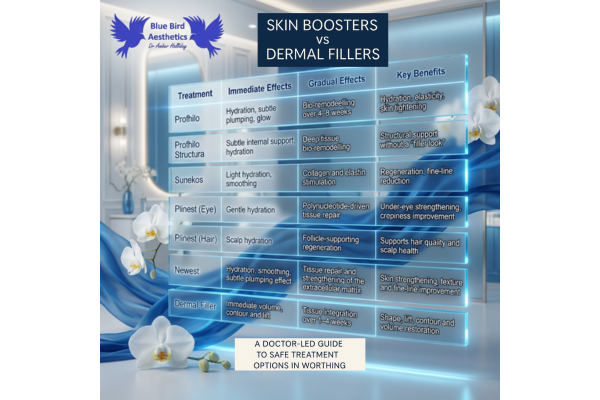
- Those weighing up polynucleotides, skin boosters and filler.
- Anyone wanting a realistic timeline before they commit.
TL;DR — Key Takeaways
Short on time? Here’s the summary:
✓ Polynucleotides suit under-eyes affected by thin skin, dark discolouration and some bags — by improving skin quality.
✓ They are not the answer to purely lymphatic puffiness; that needs a different approach.
✓ An age-related puffy lower fat pad often responds better to NeoGen, with Sunekos worked around it to even things out.
✓ Polynucleotides and filler are not rivals — filler restores volume, polynucleotides restore skin quality.
✓ With Sunekos or Jalupro you can see change from the first week; polynucleotides build to a peak 3–6 months after the third session.
✓ A consultation works out which of these your under-eyes truly need.
1. What polynucleotides do
Polynucleotides are a regenerative treatment that stimulates your own skin to repair and renew. Rather than adding volume, they improve the quality, thickness and resilience of the delicate under-eye skin, which can soften darkness and that permanently tired look. It is skin repair, not a filler.
2. The under-eye concerns they suit
Polynucleotides work well where the problem is the skin itself: thinning of the under-eye skin, darkening and discolouration, and some types of under-eye bag where skin quality is part of the story. If your concern is any of these, this is often where I would start.
3. What they will not fix — and what does
If your under-eye issue is purely lymphatic — a puffy bag from fluid — polynucleotides are not the right tool. The same is true of the lower fat pad that oxidises and puffs with age. For those, NeoGen tends to help more, and I will often work Sunekos around the rest of the pocket to even things out. The skill is matching the treatment to the actual cause.
4. Polynucleotides or filler? The wrong question
People often ask me to choose between polynucleotides and filler, but they are completely different treatments doing completely different jobs. Filler replaces lost volume; polynucleotides enhance the skin’s quality. The honest answer is not which is better, but which your under-eyes truly need — and for the under-eye, my view on filler is set out on my tear trough page.
The simple way to think about it
Volume problem? That is a filler conversation. Skin-quality problem — thin, dark, crepey skin? That is a polynucleotides or skin-booster conversation. Most tired under-eyes are the second kind.
5. A realistic timeline
This is the part anxious patients most want to know. With Sunekos or Jalupro, you tend to see visible change from the first week, improving with each session. Polynucleotides are more gradual: I can often feel the change by the second session, you can see it by the third, and the result usually peaks three to six months after that final dose. It is a slow build, but a worthwhile one.
Regenerative treatments reward patience. The under-eye you will be happiest with is the one you see months down the line, not days.
— Dr Amber Halliday
6. Who it is not for
I would not treat, or would delay, if:
- You are pregnant or breastfeeding.
- There is active infection, inflammation or broken skin in the area.
- Your concern is purely fluid-based puffiness — where a different approach is needed.
- You have certain medical conditions, which I assess individually.
Frequently Asked Questions
What are polynucleotides?
A regenerative treatment that stimulates your own skin to repair and renew, improving its quality, thickness and resilience rather than adding volume. I use Plinest.
Are polynucleotides good for dark circles?
They help where the darkness comes from thin skin or discolouration. If your circles are mostly fluid-based puffiness, a different approach is needed.
Polynucleotides or tear trough filler?
They are different treatments. Filler replaces volume; polynucleotides improve skin quality. For the under-eye I do not offer tear trough filler — I prefer skin-quality treatments.
How many sessions will I need?
Polynucleotides are given as a course, usually of three, spaced out, with results building over the following months.
How soon will I see a difference?
With Sunekos or Jalupro, often from the first week. With polynucleotides, visible by the third session and peaking three to six months after the final dose.
Will it fix puffy bags?
Not if the puffiness is purely lymphatic or from an age-related fat pad. Those often respond better to NeoGen, sometimes with Sunekos around the area.
Is there downtime?
Usually minimal — some bruising or puffiness that settles within a couple of weeks. That is an expected side effect, not a complication.
Can I have it while pregnant or breastfeeding?
No. We would wait and look at gentle skincare and sun protection in the meantime.
The Takeaway
For tired under-eyes, the question is rarely ‘filler or not’ — it is what is really causing the problem. Where it is skin quality, polynucleotides are one of the most natural ways to improve it, with no hollow to fill and no risk of the over-done look.
Where the issue is fluid or an age-related fat pad, I will tell you that, and point you to what truly helps instead.
If your under-eyes are bothering you, a consultation is the place to work out the cause and the right, realistic plan.
Ready to talk it through?
Book a calm, considered, commitment-free consultation in Worthing.
We’ll work out what is really causing your under-eye concern and match the treatment to it — with no pressure to proceed.