How Microneedling Works: A Doctor Explains Controlled Injury, Collagen and Why Medical-Grade Treatment Matters
Controlled injury, the three healing phases, why medical-grade differs from home rollers, the three types at Blue Bird, and what the treatment handles well.
By Dr Amber Halliday, MRCGP MBBS BSc (Hons) — GP & Aesthetics Doctor | Blue Bird Aesthetics, Worthing | Updated 2026
TL;DR — Key Takeaways
Short on time? Here’s the summary:
✓ Microneedling works by creating controlled micro-injuries in the skin, triggering the body’s natural wound-healing cascade to produce new collagen and elastin.
✓ The biological process happens in three phases over weeks to months — which is why results continue to improve after each session.
✓ Medical-grade devices reach deeper than home rollers, use sterile single-use cartridges, and allow precise depth adjustment per area.
✓ Three types are available at Blue Bird: standard microneedling, nanoneedling (no numbing needed, no downtime) and liquid microneedling (spicule therapy).
✓ Add-ons including Plinest polynucleotides, AlumierMD peels and LED light therapy can significantly enhance the treatment.
✓ The treatment is well-evidenced for acne scarring, enlarged pores and skin texture — and less suited to significant laxity, active acne or deep pigmentation.
The Science Nobody Explains Clearly
Microneedling has become one of the most searched aesthetic treatments in the UK. There is no shortage of before-and-after images. What is in shorter supply is a clear explanation of what the treatment is doing biologically, why results take time, and why the clinical version differs fundamentally from a home roller.
That matters, because the mechanism explains the results. It explains why results take time, why spacing matters, and why a single session improves skin quality rather than resolving significant scarring. Here is the actual science.
The Concept of Controlled Injury
The premise of microneedling is counterintuitive: controlled damage to the skin triggers its own repair. Precision micro-injuries — hundreds of tiny channels created per square centimetre of treated skin — initiate a wound-healing cascade that produces new collagen and elastin.
The key word is controlled. The depth, distribution, sterility and frequency of the injury determine whether you achieve a therapeutic result or simply irritate the skin. This is the essential difference between a medical-grade device and a home roller.
The Three Biological Phases
After microneedling, the skin goes through a wound-healing cascade that unfolds in three distinct phases over weeks to months.
Phase 1: Inflammation (hours to days)
Immediately after treatment, the micro-injuries trigger an inflammatory response. Platelets aggregate and release growth factors. Neutrophils arrive to clean the microchannels; macrophages follow to coordinate repair. This is the phase that produces the redness you see after treatment. It is not a side effect to be minimised — it is the mechanism.
Phase 2: Proliferation (days to weeks)
Fibroblasts — the cells responsible for producing collagen and elastin — migrate into the injured area and begin producing new structural protein. New blood vessels form. The skin begins to rebuild its support structure.
Phase 3: Remodelling (weeks to months)
The newly laid collagen matures and reorganises — from looser type III collagen laid down rapidly in proliferation, to denser, more structured type I collagen that closely resembles the skin’s original architecture. This phase continues for up to 12 months after a treatment session.
Why results keep improving
The remodelling phase continues long after the visible redness and swelling have gone. A session three weeks ago is still producing collagen now. This is why the full result of a course often shows at the six-month mark, not the six-week mark.
Why Medical-Grade Differs From Home Rollers
Home microneedling rollers are not the same treatment. I say this not to protect the clinic’s commercial interest, but because the difference is clinically significant.
- Depth: Professional pen devices typically work at 0.5–2.5mm, adjustable by area and concern. Home rollers have fixed, usually short needles that cannot reach the depth needed for meaningful collagen stimulation.
- Sterility: Clinical devices use single-use sterile cartridges replaced for each patient. Home rollers are reused and cannot be sterilised effectively — they introduce infection risk with every use.
- Precision: Clinical pens allow depth adjustment per area. The delicate skin around the eyes requires a different depth than the cheek or forehead.
- Tearing versus channelling: When needles are dull or dragged across skin at an angle, they tear rather than channel. Tearing produces unpredictable results and infection risk rather than controlled collagen stimulation.
The Three Types at Blue Bird Aesthetics
Proton Pen Microneedling
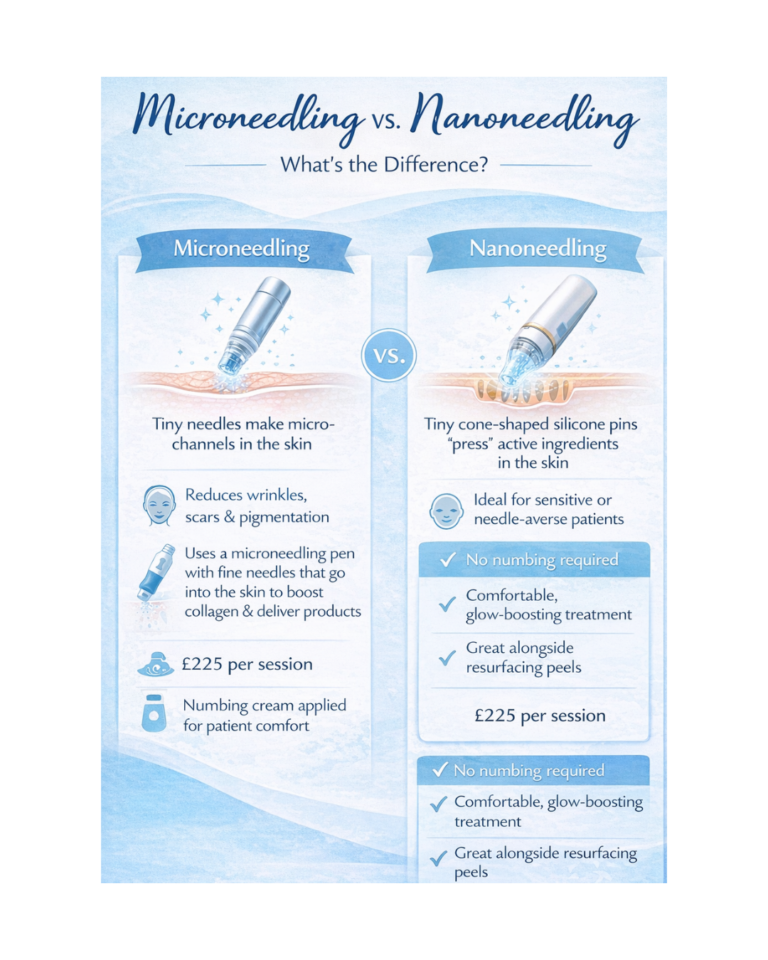
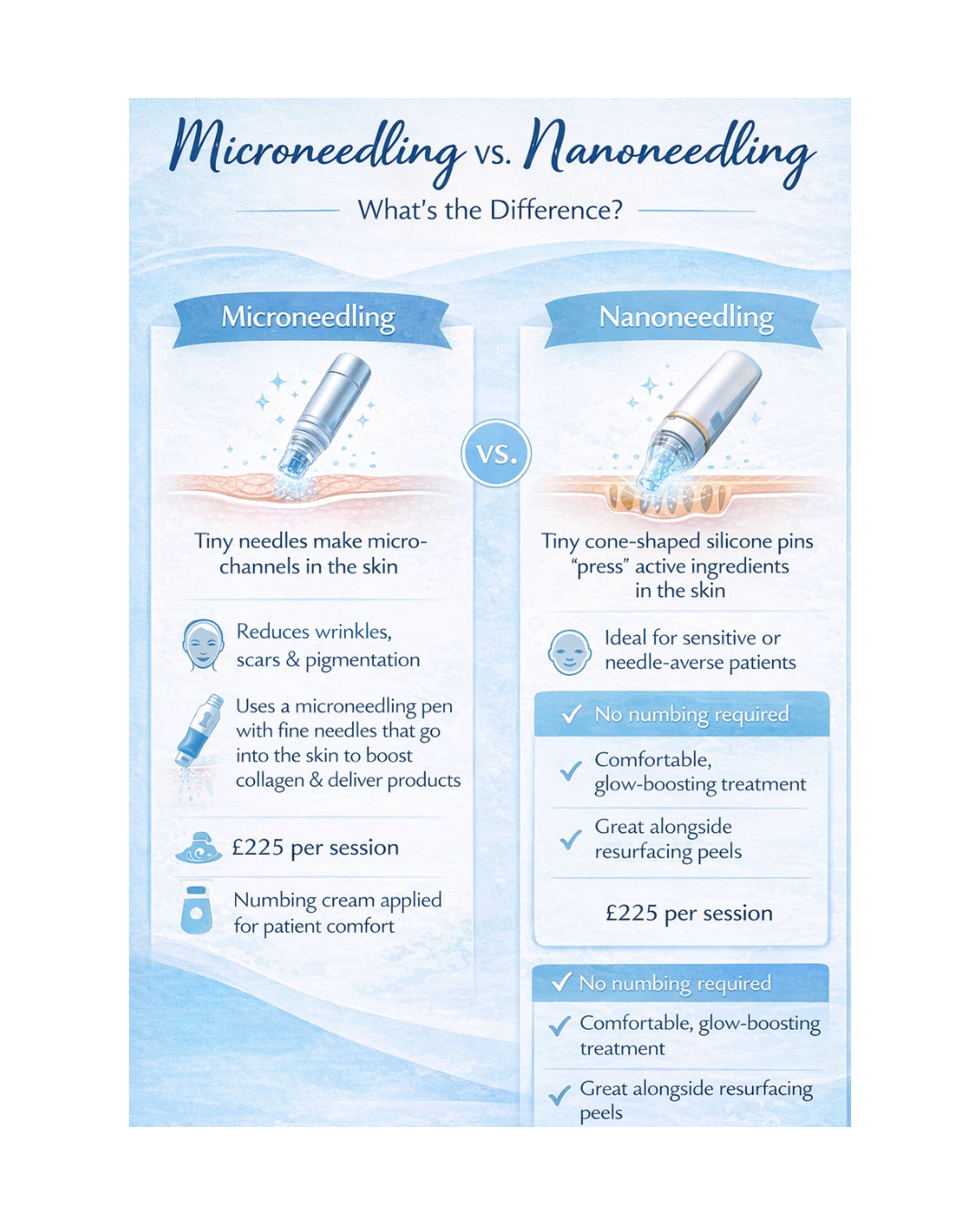
Medical-grade motorised pen device, sterile single-use cartridge, adjustable depth per area. Topical numbing applied 20–30 minutes before. Suitable for most skin quality concerns, acne scarring, pores and texture. Downtime: redness for 24–48 hours.
Nanoneedling
Uses silicone cone-shaped tips rather than true needles — the tips are too small to breach the skin barrier, so no numbing is needed, there is essentially no downtime and the treatment is suitable for sensitive skin and rosacea (in stable cases). Improves product penetration and skin radiance. An excellent starting point.
Liquid Microneedling (Spicule Therapy)
Microscopic calcium carbonate structures, sustainably sourced from sea sponge, are massaged into the skin where they act as micro-needles — triggering a similar repair cascade to standard microneedling with a different mechanism. Suitable for patients who prefer a needle-free approach to collagen stimulation.
Add-Ons That Enhance the Treatment
- Plinest Polynucleotide Infusion — Polynucleotide solution driven into the microchannels immediately after needling, where it is absorbed far more effectively than topical application. Significantly enhances regenerative benefit, particularly for acne scarring and under-eye skin.
- AlumierMD Chemical Peel — A light peel applied to add a resurfacing component. Useful for pigmentation and surface texture alongside the deeper collagen work.
- LED Light Therapy — Applied after treatment to reduce post-treatment redness, support the healing cascade and accelerate visible recovery.
What the Treatment Handles Well — and Less Well
Strong evidence and good clinical outcomes
- Atrophic acne scarring — particularly rolling and boxcar scars. A solid evidence base; multiple courses typically needed.
- Enlarged pores — one of the most consistent and relatively rapid improvements.
- Skin texture and surface roughness.
- Fine lines contributing to overall skin quality.
Where expectations need calibrating
- Significant laxity — microneedling stimulates collagen but does not remodel or tighten tissue in the way NeoGen Plasma does.
- Active acne — a contraindication, not an indication. Microneedling cannot be performed over active, inflamed breakouts.
- Pigmentation — some improvement in overall tone, but established pigmentation, particularly melasma, often responds better to targeted peels or NeoGen.
The mechanism is why the results take time. If someone promises to transform your skin with microneedling in a week, they are describing a different treatment entirely — or a different level of honesty.
— Dr Amber Halliday
Ready to talk it through?
Book a calm, considered, commitment-free consultation in Worthing.
Understanding the science is the starting point. A consultation is the next step.
Further Reading & Related Treatments
- Microneedling in Worthing: Prices, Results & How to Decide
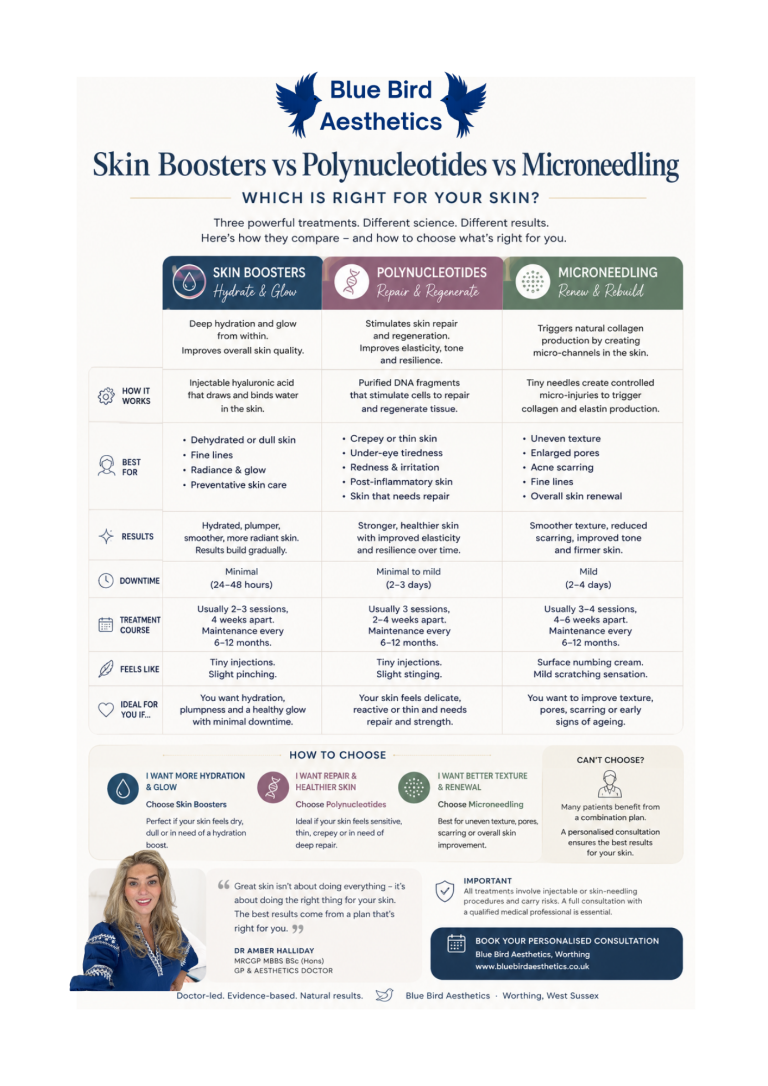
- Skin Boosters, Polynucleotides and Microneedling — How They Compare
- NeoGen Plasma — for deeper skin regeneration and laxity
- AlumierMD chemical peels — for pigmentation and resurfacing
- The Ultimate Guide to Aesthetic Treatments in Worthing
Frequently Asked Questions
Is microneedling painful?
Standard microneedling is performed with topical numbing cream applied 20–30 minutes before. Most patients describe warmth and pressure rather than pain. Nanoneedling requires no numbing.
What does the skin look like immediately after?
Redness and mild swelling for 24–48 hours with standard microneedling — similar to mild sunburn. Nanoneedling and liquid microneedling have much less visible redness.
What should I avoid after treatment?
Makeup for 24 hours. Retinoids and active acids for 3–5 days. Sun exposure. Heavy exercise and heat for 48 hours. A gentle, hydrating routine is ideal for the first week.
Can I have microneedling if I have rosacea?
It depends on the severity. In stable, mild rosacea, nanoneedling is usually well tolerated and can improve skin resilience over time. Standard microneedling in an active rosacea flare would be contraindicated.
How does microneedling compare to NeoGen Plasma?
Both stimulate collagen but through different mechanisms and to different depths. Microneedling suits most skin quality concerns. NeoGen is more appropriate for significant laxity, deeper regeneration or concerns microneedling does not adequately address. My guide to NeoGen versus gentler treatments goes into detail.