Evidence-Based Aesthetics: A GP’s Approach to Skin Health and Why It Matters
Treatments chosen because the evidence supports they are safe and effective — not because they are trending.
By Dr Amber Halliday, MRCGP MBBS BSc (Hons) — GP & Aesthetics Doctor | Blue Bird Aesthetics, Worthing | Updated 2026
In general practice, a significant part of my role is health promotion. Not treating illness once it arrives — but preventing it from arriving in the first place. We prescribe to lower blood pressure and manage cholesterol not because patients feel unwell, but because the evidence clearly demonstrates that doing so reduces the long-term risk of heart disease and stroke.
That is Evidence-Based Medicine: choosing interventions because the research supports their safety and effectiveness, not because of convention, trends or commercial interest.
I bring this same standard into my aesthetics practice at Blue Bird Aesthetics in Worthing. Every treatment I offer has an evidence base I can articulate and defend. This article sets that evidence out, treatment by treatment, in plain language.
The standard I apply is simple: if I cannot explain why a treatment works based on its mechanism and the supporting research, I will not offer it.
— Dr Amber Halliday
TL;DR — Key Takeaways
Short on time? Here’s the summary:
✓ SPF is the single most evidence-backed anti-ageing and cancer-prevention intervention available.
✓ Medical-grade skincare actives (retinoids, vitamin C, niacinamide) have published clinical evidence for their effects.
✓ Microneedling stimulates collagen via a proven wound-healing cascade; NeoGen does the same thermally.
✓ LED light therapy has peer-reviewed evidence for different wavelengths targeting different skin processes.
✓ Anti-wrinkle injections have evidence suggesting they can improve mood via the facial-feedback mechanism.
✓ Hyaluronic acid fragments from degrading filler may enrich surrounding tissue beyond the filler’s volumising effect.
✓ Skin boosters (Profhilo, Sunekos, Plinest, Newest) all have published clinical data on hydration, elasticity and fibroblast stimulation.
✓ Vitamin injections are not included here — the evidence base is a different and more complex conversation.
1. SPF — The Most Powerful Intervention in This List
I say this without qualification: if you do one thing for your skin based on evidence, it is daily sun protection. The research spans decades, is replicated consistently, and is unambiguous in its conclusions.
- Ultraviolet radiation causes direct DNA damage in skin cells, accumulating with every unprotected exposure.
- UV exposure is the primary driver of photoageing — pigmentation, laxity, texture changes and surface dullness.
- Cumulative UV exposure is the major modifiable risk factor for developing non-melanoma skin cancer.
- Daily SPF use is associated with measurable improvements in pigmentation and texture over time in controlled studies.
- A physical (mineral) SPF with zinc oxide or titanium dioxide is my preference, particularly for reactive or pigmented skin.
My guide to SPF after 40 explains why the case for daily protection only strengthens with each decade.
2. Medical-Grade Skincare and Resurfacing Peels
The difference between over-the-counter skincare and medical-grade formulations is not marketing — it is chemistry. Medical-grade means formulations that are stable, therapeutic, and backed by published data — not simply premium branding. Active ingredients need to be at therapeutic concentrations and in stable formulations that allow them to reach the layers of skin where they have their effect. Many consumer products contain actives at sub-therapeutic levels, in formulations that do not survive on the shelf long enough to deliver the claimed benefit.
Retinoids
The best-evidenced topical anti-ageing ingredient available. Retinoids (including retinol and prescription-strength derivatives) accelerate cell turnover, stimulate fibroblast activity, and reduce melanin transfer. The evidence base spans decades and multiple meta-analyses. My retinol guide explains how to use them well.
Vitamin C (ascorbic acid)
Antioxidant protection against UV-induced free radical damage, co-factor for collagen synthesis, and a competitive inhibitor of tyrosinase — the enzyme that drives melanin production. The evidence is strongest at concentrations of 10–20% in stable formulations, which is what medical-grade products provide.
Niacinamide (vitamin B3)
Anti-inflammatory properties make it well suited to reactive, acne-prone and rosacea-prone skin. Evidence also supports barrier repair and melanin regulation. One of the most versatile and well-tolerated actives available.
Resurfacing peels
Chemical peels remove the surface dead-cell layer, accelerate skin turnover, and improve the penetration of active ingredients applied afterwards. The AlumierMD * range I use in clinic is formulated to precise, clinical standards. My guide to which peel suits which skin type covers the options in detail.
3. Collagen Stimulation — Two Routes, One Goal
The decline in collagen is one of the primary biological mechanisms of skin ageing. From the mid-twenties, production slows; around menopause, it falls more sharply. The evidence-based response is not to add collagen from outside (topical collagen products cannot penetrate the skin) but to stimulate the body’s own fibroblasts to produce more.
Two treatments I offer do this through different mechanisms:
Microneedling
Controlled micro-injuries trigger the skin’s wound-healing cascade: platelets release growth factors, fibroblasts migrate and proliferate, and new collagen and elastin are laid down over a three-phase process that continues for months. The evidence base for texture improvement, enlarged pores and atrophic acne scarring is strong and consistent. My guide to how microneedling works explains the biology in full.
NeoGen Plasma
Controlled nitrogen plasma energy heats the dermis uniformly, stimulating fibroblast activity and triggering collagen remodelling without needles and without removing the skin’s surface. This thermal mechanism is particularly effective for crepey texture, early laxity, and the delicate peri-orbital and eyelid skin. My NeoGen comparison guide puts it alongside the alternatives.
The shared principle
Both microneedling and NeoGen work with the skin’s own biology — prompting it to rebuild rather than adding an external material. The result looks natural because it is natural: your own collagen, stimulated and reorganised.
4. LED Light Therapy — Wavelengths and Their Evidence
LED (light-emitting diode) therapy uses specific wavelengths of light to trigger biological responses in skin cells. Different wavelengths penetrate to different depths and interact with different cellular targets. The evidence is strongest for three:
- Red light (630–660 nm) — activates mitochondrial cytochrome c oxidase, increasing ATP production in fibroblasts. This supports collagen synthesis, wound healing and post-procedure recovery. Evidence supports its use alongside and after procedures such as microneedling.
- Blue light (415–420 nm) — activates porphyrins within Cutibacterium acnes, the bacterium associated with inflammatory acne, causing bacterial cell death. Peer-reviewed studies demonstrate reductions in inflammatory acne lesion counts.
- Near-infrared (800–900 nm) — penetrates beyond the epidermis into deeper dermal and subcutaneous tissue. Evidence for reducing post-treatment inflammation and supporting deeper repair processes.
I use LED as an add-on following microneedling, where it helps manage the inflammatory response and supports the early phases of healing.
5. Anti-Wrinkle Injections — and the Mood Research
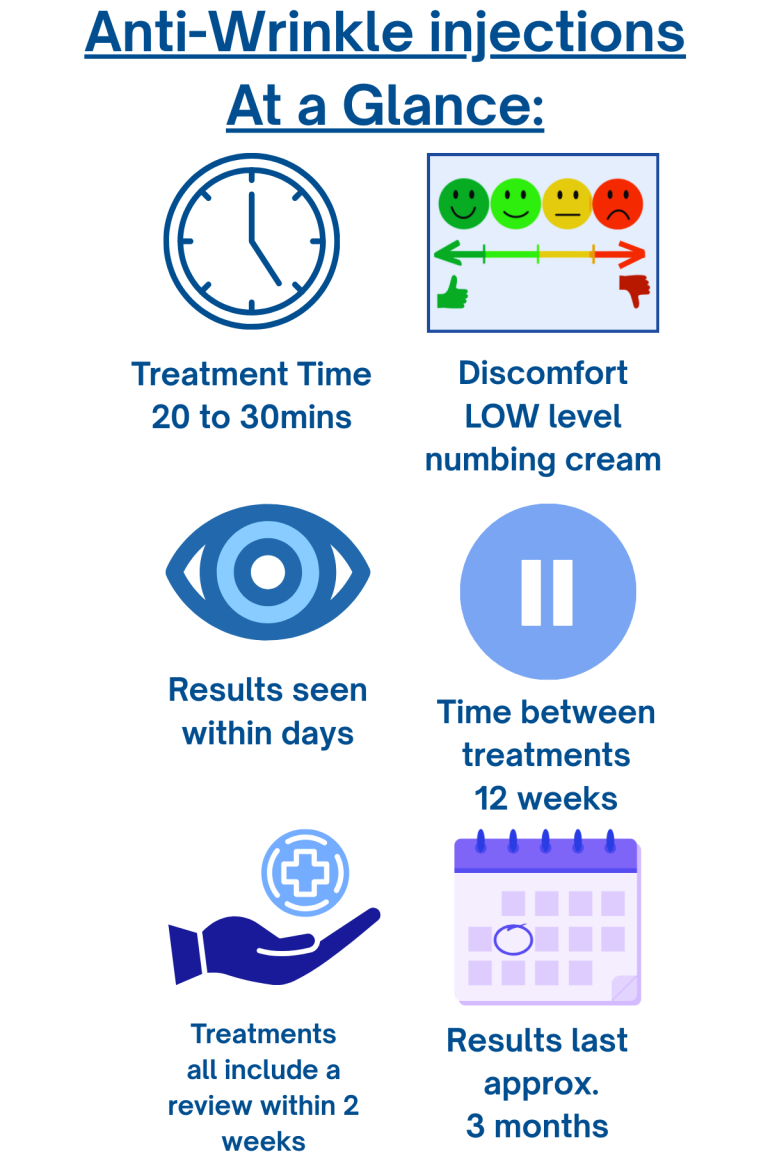
Anti-wrinkle injections are the most requested aesthetic treatment in the UK, and their safety and efficacy profile for dynamic expression lines is well established. But there is an additional strand of evidence that many patients find surprising.
The facial feedback hypothesis proposes that facial muscle activity is not merely the expression of emotion but a contributor to it — that the muscles you use to frown feed emotional signals back to the brain, amplifying negative affect. Studies by Finzi and Rosenthal (2014) and Wollmer et al. (2012) tested this in aesthetics patients and found that reducing glabellar frown muscle activity with botulinum toxin was associated with measurable reductions in depression scores in patients with depressive symptoms.
This does not mean anti-wrinkle injections are a treatment for depression — they are not. It does mean the evidence is more interesting and layered than most people assume. Patients who report looking more rested may be experiencing more than a cosmetic change.
A note on evidence quality
The facial feedback research has had a complex replication history — Strack et al.’s original 1988 work failed a large-scale replication attempt, though subsequent studies using facial injections rather than the pen-in-mouth method have held up better. The honest position: this is suggestive and published evidence, not settled consensus. It is worth knowing about, and worth not overstating. My full guide to how anti-wrinkle injections work covers the well-established mechanism.
6. Dermal Fillers — What Happens as They Break Down
Hyaluronic acid fillers restore lost volume and structural support, and this volumising effect is their primary purpose. But there is a secondary mechanism that is underappreciated: what happens as the filler degrades.
As cross-linked HA breaks down enzymatically, it releases oligomeric HA fragments that interact with CD44 receptors in surrounding fibroblasts. Research suggests these fragments stimulate fibroblast activity, improving the hydration retention and elasticity of the surrounding tissue beyond what the filler itself contributed while present. This may explain why skin quality around previously treated areas often improves over time, even as the volumising effect fades.
It also reinforces the argument for conservative, well-placed filler over excessive treatment: modest, anatomically considered filler delivers both the immediate volumising benefit and this longer-term tissue enrichment effect. More filler does not mean more of this — it means more product, more risk, and a less natural result. More on the science in my guide to the science of dermal fillers.
7. Skin Boosters — The Evidence by Product
Skin boosters sit within the broader category of regenerative injectable treatments. They differ from fillers in that they are not placed to add volume — they are distributed across the skin to improve its quality, hydration and resilience from within. Each of the four I offer has a published evidence base:
Profhilo
A high-concentration, non-cross-linked HA that spreads through tissue rather than sitting in a defined location. Stimulates four types of collagen and elastin through fibroblast activity. Nine published clinical papers demonstrating improvements in skin laxity, hydration and elasticity. One of the best-supported skin booster products available.
Sunekos
A unique combination of hyaluronic acid and amino acids — specifically the six amino acids required for collagen and elastin synthesis. Clinical studies show stimulation of type I and type III collagen, dermal regeneration and improvement in fine-line texture. Particularly useful for the under-eye area and periorbital skin.
Plinest (polynucleotides)
Contains PDRN (polydeoxyribonucleotide) derived from salmon DNA. The biological mechanism involves stimulating A2A adenosine receptors, driving cellular repair, hydration and fibroblast activation. A well-researched formulation with multiple published clinical trials. I use it both as a standalone treatment and as an add-on to microneedling.
Newest (polynucleotides)
A newer polynucleotide formulation with an FDA-reviewed safety profile. Early clinical data are consistent with Plinest findings. As with all newer formulations, I follow the evidence as it matures and apply the same standard I apply to all treatments: the evidence must support it before I offer it.
My guide to Profhilo and skin boosters and polynucleotides for under-eyes go into each in more detail.
The Takeaway
Evidence-based medicine is not a posture — it is a practice. It means asking, for every treatment: what is the mechanism, what does the research show, and what are the limits of that evidence? Those are the questions I ask before I add anything to the list of treatments at Blue Bird Aesthetics.
It also means being clear about what the evidence does not support. This article does not include vitamin injections, because the evidence base for skin benefits is inconsistent and often misrepresented. If you would like to discuss that topic specifically, as a GP I can have a nuanced conversation about it in its correct clinical context — deficiency correction, not skin treatment.
The treatments above have a clear mechanism, a published evidence base, and a safety profile I am confident in. That is what you are choosing when you choose Blue Bird Aesthetics.
Evidence matters. Safety matters. And your skin deserves treatments that work — not just good marketing.
— Dr Amber Halliday
Ready for an evidence-led consultation?
A calm, considered, commitment-free appointment with a GP who has read the research.
Frequently Asked Questions
Why does evidence matter in aesthetics?
Because aesthetics is a largely unregulated sector where marketing language often outpaces the science. As a GMC-registered GP, I apply the same evidence standard I use in clinical medicine.
Which aesthetic treatment has the strongest evidence?
Daily SPF has the most robust, longest-standing evidence base. Among in-clinic treatments, microneedling for acne scarring and anti-wrinkle injections for dynamic lines are among the most consistently evidenced.
Is there evidence for skin boosters?
Yes — each of the four I offer (Profhilo, Sunekos, Plinest, Newest) has published clinical data on hydration, elasticity and fibroblast stimulation, though evidence quality varies between formulations.
What is the facial feedback hypothesis?
The idea that facial muscle activity contributes to emotional experience rather than just expressing it. Research specifically on glabellar botulinum toxin injections has found associated improvements in mood in patients with depressive symptoms.
Why don’t you include vitamin injections in this article?
The evidence base for vitamin injections as a skin or aesthetic treatment is inconsistent and often misrepresented by the industry. They belong in a separate conversation about correcting deficiency and supporting wellbeing — not alongside collagen stimulation and SPF.
Do dermal fillers have long-term benefits beyond volume?
Research suggests that as HA filler degrades, the released fragments stimulate surrounding fibroblasts and improve tissue quality. This is a secondary benefit, separate from the primary volumising effect.
How do I know if a clinic uses evidence-based treatments?
Ask them. Ask what the evidence is for any treatment they recommend. A clinic that cannot explain the mechanism and the research — or deflects with marketing language — is telling you something.
Related reading: Anti-Wrinkle Injections in Worthing NeoGen Is Medical-Grade Skincare Worth It? · The Ultimate Guide to Aesthetic Treatments
* Affiliate link. We may earn a small commission if you buy through it, at no extra cost to you. We only recommend products we use and prescribe in clinic.