NeoGen Plasma vs Other Skin Rejuvenation Treatments: A Doctor’s Comparison
Lasers, microneedling, skin boosters, polynucleotides, peels — and now plasma. A doctor explains how to compare them clearly.
By Dr Amber Halliday, MRCGP MBBS BSc (Hons) — GP & Aesthetics Doctor | Blue Bird Aesthetics, Worthing | Updated 2026
TL;DR — Key Takeaways
Short on time? Here’s the summary:
✓ NeoGen uses nitrogen plasma to regenerate skin from within — no ablation, no needles, no open wounds.
✓ CO₂ laser resurfaces more aggressively and suits deeper scarring and wrinkles, with significantly more downtime.
✓ RF microneedling is widely marketed but — in my view — does not trigger the same deep collagen cascade as NeoGen or laser.
✓ Standard microneedling is excellent for texture, pores and acne scarring; NeoGen handles laxity and crepiness better.
✓ Skin boosters and polynucleotides improve hydration and skin quality; NeoGen provides structural regeneration.
✓ Peels brighten and resurface the surface; NeoGen regenerates deeper.
✓ Many patients benefit from combining NeoGen with other treatments — the choice is rarely either/or.
✓ A consultation establishes which treatment, or combination, is the right match for your skin.
Looking for pricing and booking information?
This article is a clinical guide to NeoGen Plasma treatments. For prices, packages and to book a consultation, visit our Neogen treatment page.
Skin rejuvenation has never offered more options, and that abundance of choice is truly useful — but only if you understand what you are choosing between. I see patients regularly who have been recommended NeoGen by a friend, or who have read about it online, but who are not sure how it relates to the treatments they have already considered: laser, microneedling, skin boosters, polynucleotides, chemical peels.
This guide is my clinical answer to that question. I will explain what each treatment does, how it compares with NeoGen, and — most importantly — which concerns each one addresses best. My goal is to help you come to a consultation knowing the right questions to ask, rather than already locked into a treatment that may not be the right fit.
If you are new to NeoGen entirely, my full guide to what NeoGen Plasma is and how it works is the right place to start. If you want the detail on downtime, costs and what to expect, that is in my NeoGen cost, results and recovery guide. This post is for the comparison: NeoGen against everything else.
The right treatment is not the most powerful one, or the newest one — it is the one that matches your skin, your concern and your life. That matching is what a consultation is for.
— Dr Amber Halliday
Who This Guide Is For
- Anyone who has heard about NeoGen and wants to understand how it sits alongside other options.
- People who have been told they need laser and want to understand their alternatives.
- Anyone currently considering microneedling, skin boosters or peels and wondering whether NeoGen would serve them better.
- Patients who want a doctor’s honest, clinical view rather than a clinic’s promotional one.
1. What Makes NeoGen Different From Everything Else
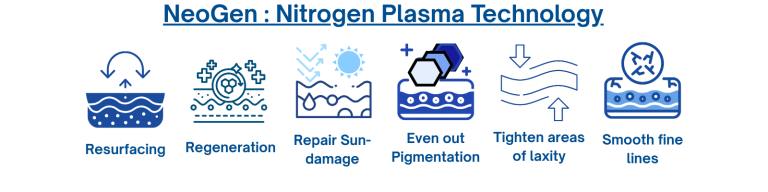
NeoGen Plasma uses controlled nitrogen plasma energy to heat the skin in a uniform, predictable way. It is not a laser — it uses no light energy. It is not microneedling — it uses no needles and creates no mechanical channels. It is not a peel — it does not remove the skin’s surface layers.
Instead, it creates a thermal regeneration effect: controlled heat that prompts the skin to rebuild its collagen and elastin from within, without ablating or wounding the surface. That distinction is important, because it changes both what the treatment is suited to and what the recovery looks like.
NeoGen can be delivered at different energy settings — lower for more sensitive areas and skin types, higher for greater regenerative effect — and this adaptability is part of why it suits a wider range of concerns than many single-modality treatments.
The three key properties that set NeoGen apart
First, it is regenerative rather than ablative — the skin rebuilds rather than being removed. Second, it has no open wounds, which changes the infection risk and recovery profile. Third, it is suitable for areas that laser cannot safely treat, including the eyelids and peri-orbital skin. Full detail on the mechanism is in my NeoGen Plasma guide.
2. NeoGen vs CO₂ Laser
CO₂ laser is often described as the gold standard for deep skin resurfacing, and for certain concerns that description is fair. It is a powerful ablative treatment — it removes columns of skin tissue, which triggers significant collagen remodelling. The results can be dramatic. The downtime and recovery are also significant.
NeoGen offers a different approach. Rather than removing skin, it regenerates it from within. That means a different recovery profile, a lower risk of post-inflammatory hyperpigmentation in darker skin tones, and suitability for areas where laser cannot safely be used.
NeoGen Plasma | CO₂ Laser | |
|---|---|---|
How it works | Nitrogen plasma heats uniformly; regenerative | Light energy vaporises skin columns; ablative |
Downtime | Bronze tone, light peeling, 3–7 days | Raw skin, crusting, oozing — 7–14 days |
Open wounds | No | Yes — significant infection‑management required |
Pain | Comfortable with topical anaesthetic | Often requires nerve blocks or sedation |
Pigmentation risk | Lower; suitable for broader skin tones | Higher risk in darker Fitzpatrick types |
Eyelids | Yes — one of NeoGen’s strongest indications | High risk; rarely used around eyes |
Best for | Crepiness, early laxity, eyelids, overall quality | Deep wrinkles, severe acne scarring, heavy sun damage |
A note on laser and pigmentation
Ablative CO₂ laser is generally not my first choice for treating pigmentation and carries a greater risk of post-inflammatory hyperpigmentation, particularly in darker skin types.
3. NeoGen vs Radiofrequency Microneedling
Radiofrequency microneedling — devices that combine needles with radiofrequency heat — is one of the most widely marketed skin treatments available. You will see it promoted aggressively online, often with significant claims about tightening and lifting.
I do not offer RF microneedling at Blue Bird Aesthetics, and this is a considered clinical decision rather than a commercial one. In my interpretation of the current evidence, RF microneedling has not demonstrated the same degree of collagen remodelling as NeoGen Plasma or ablative laser treatments, although both have an important role for selected patients. Based on my appraisal of the available evidence and my treatment philosophy, I have chosen not to offer RF microneedling in my practice. I discuss this in more detail in my guide to choosing between NeoGen and gentler treatments.
That said, I include it here because many patients come having already been told about it, and a fair comparison is more useful than a dismissal.
NeoGen Plasma | RF Microneedling | |
|---|---|---|
How it works | Plasma thermal regeneration; no needles | Needles penetrate skin and deliver RF heat |
Collagen stimulation | Deep regenerative cascade | Superficial-to-mid depth; variable evidence |
Eyelids | Yes | No — not suitable around eyes |
Fat loss risk | No; maintains natural volume | Possible at higher settings — a meaningful risk in the face |
Acne scars | Improves texture and pigmentation | Often preferred for deeper scar indentation |
Downtime | 3–7 days bronze / light peeling | 2–5 days redness, grid marks |
My view | Offered at Blue Bird Aesthetics | Not offered — evidence does not meet my standard |
Why fat loss in the face matters
At higher RF settings, subcutaneous fat can be destroyed. In the body this may be desirable. In the face, where fat compartments provide the volume and structure we associate with a healthy, youthful appearance, it is a risk I am not willing to take with patients’ faces. NeoGen does not destroy fat.
4. NeoGen vs Microneedling
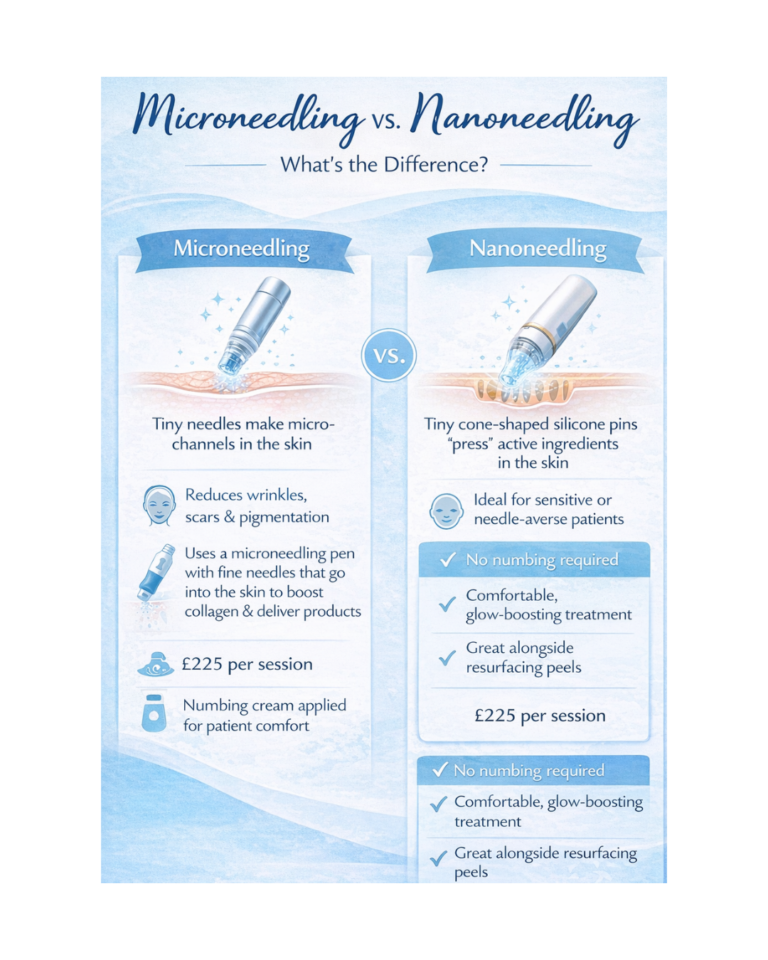
Microneedling is one of the treatments I use and rate most highly for the right concern. It creates controlled micro-injuries that prompt the skin’s own wound-healing response — stimulating collagen and elastin production gradually over a course of sessions. The mechanism, the three biological healing phases, and why medical-grade devices matter are covered in detail in my guide to how microneedling works.
The comparison with NeoGen is one of depth and target, not quality. Microneedling is excellent within its scope; NeoGen reaches further into the territory of structural regeneration and laxity that microneedling alone cannot address.
NeoGen Plasma | Microneedling | |
|---|---|---|
Mechanism | Thermal plasma regeneration | Mechanical micro-injury, collagen cascade |
Downtime | 3–7 days | 24–48 hours redness |
Acne scarring | Improves texture and pigmentation | Strong evidence — preferred for rolling/boxcar scars |
Crepey skin | Excellent | Modest improvement |
Early laxity | Yes — a key indication | Limited effect |
Eyelid skin | Yes | No |
Pores and texture | Good | Very good — often faster visible result |
Combine? | Yes — often a strong combination | Can be combined with NeoGen in a course |
For significant acne scarring, microneedling often comes first — or is combined with polynucleotides to maximise regeneration. My guide to microneedling for acne scarring covers which scar types respond best and which need a different approach.
5. NeoGen vs Skin Boosters and Polynucleotides
These are injectable treatments that work at a different level to NeoGen. Skin boosters such as Profhilo and Sunekos improve hydration and skin quality by delivering hyaluronic acid into the skin, stimulating surface glow and resilience. Polynucleotides such as Plinest or Newest go further — stimulating fibroblast activity and cellular repair, with particular benefit around the eyes and in skin that needs regenerative support rather than hydration alone.
None of these are substitutes for NeoGen, and NeoGen is not a substitute for them. They address different levels of the same problem, which is why combining them is often the most effective approach.
NeoGen Plasma | Skin Boosters / Polynucleotides | |
|---|---|---|
Mechanism | Thermal plasma regeneration | Injectable HA (boosters) or DNA fragments (polynucleotides) |
Primary effect | Structural collagen and elastin regeneration | Hydration, glow, cellular repair |
Injectables? | No | Yes |
Downtime | 3–7 days | 24–72 hours (bruising / minor swelling) |
Duration of effect | 12–24 months | 3–6 months (boosters); 6–12 months (polynucleotides) |
Best for | Laxity, crepiness, overall regeneration | Hydration, under-eye quality, cellular resilience |
Combine? | Yes — frequently and effectively | Can be used before or after a NeoGen course |
Skin boosters and NeoGen are not rivals. A course of skin boosters before NeoGen improves the skin’s starting condition; polynucleotides alongside or after can extend the regenerative benefit. This is how I plan treatment when skin quality is the overall goal.
— Dr Amber Halliday
6. NeoGen vs Chemical Peels
Resurfacing peels use acids to remove the skin’s uppermost layers, which brightens the complexion, reduces surface pigmentation, and stimulates the turnover of newer, healthier skin cells beneath. They are excellent at what they do — which is primarily surface-level improvement. AlumierMD peels, which I use in clinic, can be combined with microneedling for additional depth, or layered as a maintenance treatment between NeoGen courses.
NeoGen Plasma | Chemical Peels | |
|---|---|---|
Mechanism | Thermal plasma — regenerates deeper layers | Acids remove superficial skin layers |
Depth of effect | Mid to deep dermis | Epidermis and superficial dermis |
Pigmentation | Improves deeper sun damage | Brightening, superficial pigment |
Crepey texture | Excellent | Modest benefit |
Downtime | 3–7 days | 0–5 days depending on strength |
Combine? | Yes — peels as maintenance between NeoGen sessions | Works well alongside microneedling and NeoGen |
7. Which Treatment Is Best For…
Rather than making a single recommendation, I think it is more useful to give you the honest answer for each specific concern:
Crepey eyelid or peri-orbital skin
→ NeoGen Plasma
One of its strongest and most specific indications. The NeoGen treatment page explains what to expect.
Crepey texture on face, neck or chest
→ NeoGen Plasma
Thermal regeneration addresses the structural loss of collagen and elastin that creates crepiness. Other treatments offer modest help; NeoGen is the most effective option I offer.
Acne scarring — rolling and boxcar types
→ Microneedling (possibly with polynucleotides)
The evidence base here strongly supports microneedling for atrophic scarring. NeoGen improves texture and pigmentation but the deeper structural work on scars is better served by a microneedling course. Full detail on scar types and which respond best.
Surface brightness and pigmentation
→ Resurfacing peels, possibly with NeoGen
Peels address the superficial pigment quickly; NeoGen improves the deeper sun damage. Often a strong combination for significant sun-damaged skin. More on peels in Worthing.
Hydration and glow as the primary goal
→ Skin boosters (Profhilo, Sunekos)
If the main issue is dehydration and lack of radiance rather than structural concerns, skin boosters often give a faster, more targeted improvement. More on skin boosters.
Cellular repair and elasticity
→ Polynucleotides (Plinest)
Particularly effective around the eyes and for skin needing repair at a cellular level rather than volume. More on Plinest polynucleotides.
Overall skin quality — a whole-face regenerative approach
→ NeoGen, often combined
When the goal is broad regeneration — improving texture, tone, early laxity, and long-term collagen — NeoGen as the anchor treatment, with boosters and skincare around it, is the plan I most often put together.
Which treatment is best?
There is no single “best” skin rejuvenation treatment. The right treatment depends on your skin concern, skin type, desired downtime, budget, and long-term goals. Many patients achieve the best outcomes by combining treatments rather than relying on one alone.

8. My Clinical View
NeoGen is not the right treatment for every skin concern, and I would not present it as such. Where it sits in my practice is specific: it is the treatment I reach for when the goal is overall skin quality, early laxity, crepey texture, or peri-orbital ageing, and when the patient is ready to accept the five to seven days of downtime that a proper NeoGen treatment requires.
It works best as part of a longer-term plan rather than a one-off. The skin needs preparation — good medical-grade skincare and ideally a course of skin boosters beforehand — and it needs proper aftercare to protect the result. Patients who commit to that plan get results that last twelve to twenty-four months and that improve the skin in a way no superficial treatment can match.
Where NeoGen is not the answer — where microneedling, or peels, or boosters alone will serve someone better — I say so. The comparison in this guide is the same conversation I have in a consultation. Understanding the options is what makes a good decision possible.
NeoGen is not a replacement for every skin treatment — it fills a very specific, important role. The patients who get the most from it are those who understand what they are committing to, and who approach it as part of a longer skin-health plan.
— Dr Amber Halliday
Frequently Asked Questions
Is NeoGen better than laser?
It depends on the concern. CO₂ laser is more aggressive and suits deeper wrinkles and severe scarring. NeoGen is regenerative rather than ablative, suits a broader range of skin tones, is safer around the eyelids, and has a more predictable recovery. Neither is universally better.
Can NeoGen replace microneedling?
They do different things. Microneedling has a strong evidence base for acne scarring and pore refinement. NeoGen handles laxity, crepiness and peri-orbital skin better. They complement each other rather than replace each other.
Why don’t you offer RF microneedling?
I have reservations about the evidence for long-term collagen remodelling with RF microneedling, and I am not comfortable with the risk of inadvertent fat loss in the face at higher settings. I prefer treatments I am confident in.
Can I have NeoGen and skin boosters?
Yes — and often I recommend skin boosters as preparation before a NeoGen course, to improve the skin’s condition going into the treatment. Polynucleotides can also be used alongside or after to extend the regenerative benefit.
How do I know which treatment I need?
A consultation. Your skin type, concerns, tolerance for downtime, and overall skin health all influence the recommendation. The comparison in this guide gives you a framework; the consultation gives you the specific answer.
Is NeoGen suitable for all skin tones?
It has a broader suitability range than many laser treatments, which carry higher post-inflammatory hyperpigmentation risk in darker skin tones. A full assessment at consultation establishes suitability for your individual skin.
How long do NeoGen results last compared to other treatments?
NeoGen results typically last twelve to twenty-four months — longer than most alternatives. Skin boosters last three to six months; microneedling courses twelve months or so. Laser results can be long-lasting but vary.
What is the downtime compared to other options?
NeoGen involves three to seven days of a bronze tone and light peeling. Microneedling is twenty-four to forty-eight hours of redness. CO₂ laser can be seven to fourteen days of more significant recovery. Skin boosters have minimal downtime — twenty-four to seventy-two hours at most.
Should I start with something gentler than NeoGen?
Often yes — particularly if your skin is new to treatment, you are unsure of your tolerance, or your primary concern is hydration rather than regeneration. My guide to NeoGen versus other skin treatments covers this decision in detail.
The Takeaway
The choice between NeoGen and other skin rejuvenation treatments is not about which is newest or most powerful. It is about matching the depth and mechanism of the treatment to the depth and nature of your concern.
NeoGen fills a specific, valuable role: structural regeneration, crepiness, early laxity, eyelid skin, and overall skin quality improvement across a meaningful time horizon. Where microneedling, peels or skin boosters serve a concern better — or where combining them creates a stronger outcome — that is the honest recommendation I make.
If I were treating myself or a member of my family, I wouldn’t automatically choose NeoGen. I’d first ask what the real concern was. If it was acne scarring, I’d lean towards microneedling. If it was dehydration, skin boosters. If it was crepey eyelids or overall skin quality, NeoGen would be high on my list. The best treatment is the one that matches the problem—not the one with the biggest marketing budget.
— Dr Amber Halliday
If you would like to talk through which option — or combination — is right for your skin, a consultation is the right starting point. You can also read more about what NeoGen Plasma is and how it works and what NeoGen costs, what results to expect and what recovery involves before you come.
Ready to talk it through?
Book a calm, considered, commitment-free consultation in Worthing.
We’ll assess your skin and match the treatment — or combination — to your concern, lifestyle and goals.
Further Reading & Related Treatments
- What Is NeoGen Plasma? A Doctor’s Guide
- NeoGen Plasma: Cost, Results & Recovery
- NeoGen Plasma Treatment Page
- Do You Need NeoGen, or Something Else?
- Microneedling vs Injectables vs NeoGen: Comparison Hub
- How Microneedling Works: A Doctor Explains
- The Ultimate Guide to Aesthetic Treatments in Worthing
Considering NeoGen?
You can use these tools as gentle guides, but your safety and suitability are always assessed properly during a full medical consultation.
NeoGen Suitability Quiz → NeoGen Downtime Calculator →Prefer a broader guide to see which treatments might suit your skin?
Treatment Finder Quiz →